Biographies - Hancock Co.
GA
Charles
Abercrombie
Grave
Site
Laid out the town of Sparta from his own
lands in 1795. Legislator.
Finding
his grave.
James
M. Archer
planter, Hancock Co., Ga. The gentleman herein
named is one of the old-school planters of Hancock county, and is living
on the same plantation which his father cultivated before him. He is one
of that class of planters who believe in raising their own "hog and
hominy." who make their farms self-substaining, and who are to-day the
only prosperous people in the state. Would that Georgia had more of them.
They are the bone and sinew of the country. Grandfather William Archer
came to Hancock county early in the present century. He lived to
a good old age, and reared a large and prosperous family. William was the
father of James M. and was born in the county in 1812. He married in 1833
Miss Elizabeth Jackson, who was of German descent, and was also a native
of the county. But two children were born to the union: William J., who
married and reared a family in the county, and died in 1889, and James
M, whose name heads this sketch. The mother of these boys was a woman of
fine qualities, and taught them to "fear God and regard man" in all the
walks of life. She died at a ripe old age in 1878. William Archer was a
man of iron constitution and a capacity and will for hard work equalled
by but few in his day. He began life in very moderate circumstances and
by middle age had placed himself in the ranks of the wealthy planters of
the county. The was no accomplished by trading and short practices, but
by actually "digging it out of the soil." During his life-time he was a
liberal supporter of the Baptist church, and is remembered as a man of
large hospitality and generous impulses. he died in 1887. James M. Archer
has followed in his father's footsteps, and is looked upon as a man equally
as valuable to the community. His public spirit is proverbial, and he occupies
a high place in church and society, holding the respect of all who know
him. He was born Jan. 12, 1837, and was given such education as the common
schools of the county afforded. He married his present estimable wife,
Clarissa Ann Peeler, March 21, 1861. She was a daughter of Rev. Berry Peeler,
who came from South Carolina, and was for many years prior to his death
a prominent and gifted minister of the Baptist church. Twelve children
resulted from this union as follows: Ida J., deceased; Addie L., widow
of Dr. L. S. Garner, living now with her parents; William B., deceased;
Flavious J., planter, Hancock county; Sarah B., deceased; Green P.; J.
Harvey, an infant, unnamed; Anna May, Jesse Mercer, Lillian E., and Isaac
Holmes. Mr. Archer is one of the heaviest land-owners in the county, paying
tax on some 3,000 acres of land. He lives on the old Archer plantation,
eight miles south of Sparta, in a commodious new house, surrounded by such
comforts as make life pleasant in the county. During the late war he did
his whole duty as a private soldier in Company E, Thirty-second Georgia
regiment, Col. George P. Harrison, commanding. he enlisted in 1862 and
served on the coast defenses in South Carolina, Georgia and Florida, participated
in the battle of Ocean Pond, in the latter state, and the bombardment of
Battery Wagoner, near Savannah. Mr. Archer is a democrat in political belief,
and a deacon in the Baptist church. Socially he is regarded highly, being
a gentleman of entertaining conversational powers and of most hospitable
disposition. Memoirs of Georgia Volume 1Historical Society
of Georgia, 1895
A.S
Bass
postmaster, depot agent and storekeeper, Devereaux,
Hancock Co., Ga, a station on the Macon and Augusta railway, in the western
part of the county. Mr. bass comes from good old Virginia stock, from which
state his grandfather, Edmund Bass, emigrated when in his teens. Mr. Bass'
father married a Miss Ingram, and settled in the western part of the county,
where he reared family of four sons and five daughters: Milton, married
Ann Culver, a sister of Hardy C., whose family is mentioned elsewhere,
and became the father of the following children: Ann E., Mrs. Wm. Coleman,
Deveareaux; W. H., Macon; A. S., the subject of this sketch; Carrie G,
widow of J. W. Mote, Devereaux; George E., private Company K, Fifteenth
Georgia regiment, wounded and captured at Gettysburg, died in a Federal
prison; Wesley A., planter near Devereaux; Hardy W., Baldwin county; Mary
J., deceased; Sallie E.; Mrs. Wm. Brown, Devereaux; Mattie L., Mrs.
F. A. Hall, Milledgeville. Mrs. Bass died in 1869. She was a woman of superior
qualities and is remembered by her children as a mother faithful and true
to their best interests. The father lived till 1883. He early mastered
the art of successfully tilling his native heath, and was regarded as an
authority on all questions pertaining to agriculture. he accumulated a
good estate, and in his public and private benefactions was liberal and
just. He was a member and active worker in the Methodist church, and as
such is remembered as being of peculiar and wonderful power in prayer.
Although not an educated man, when "talking to the Lord" he had a command
of language seldom surpassed. "Syd" Bass, as he is familiarly known, came
to manhood on the wave that ushered in the civil war, having been born
June 22, 1841. he enlisted as a private in Company K, Fifteenth Georgia
regiment, in 1861. He participated in some of the hardest fought battles
of the war, notably the seven days' fight around Richmond, Fredericksburg,
Sharpsburg, Gettysburg, Chancellorsville and Second Manassas, and wears
the marks of two Yankee bullets, having been wounded in the shoulder at
Sharpsburg, and in the thigh at Second Manassas. Witnessing the surrender
of his beloved chieftain at Appomattox, he returned home, gladly laying
down the implements of war to engage in the industries of peace. The business
of Mr. Bass since the war has been such as to give him a large acquaintance
in the county, among whom he is regarded as a faithful and conscientious
official. He is a democrat, is a Mason and belongs to the Methodist church.
The marriage of Mr. Bass was consummated with Miss Ella C. Simmons in 1872,
who is the mother of three children: George E., died in infancy; Anna le
Gay and Ora E., young ladies at home. Memoirs of Georgia
Volume 1 Historical Society of Georgia, 1895
Charles
Larkin Bass
lawyer, Clarkesville, Habersham Co., Ga., son
of Dr. Charles H. and Mattie (Greene) Bass, was born near Milledgeville,
Baldwin county, Ga., April 30, 1869. His great-grandfather on his father's
side was Wm. Rabun, once governor of Georgia, and for whom Rabun county
was named. William Rabun was born in Halifax county, N.C., April 8, 1771,
and came to Georgia in 1795 with his father Matthew Rabun, who settled
in Wilkes county, and a year later moved thence to Hancock county. Though
but indifferently educated, he possessed mental endowments and a personality
that brought him into popular favor, and he was elected repeatedly to both
the lower and upper house of the general assembly. He was president of
the senate when Gov. Mitchell resigned in March, 1817, and was acting governor
from that time until November, when he was elected governor, and afterward,
by the people, for a full term, during which he had a spicy correspondence
with Gen. Jackson. He died on his plantation in Hancock county while governor,
Oct. 24, 1819, and his message was delivered to the general assembly by
the president of the senate, Matthew Talbot, who succeeded him. Dr. Larkin
Bass, an eminent physician, who married Miss mary, a daughter of Gov. Rabun,
was the grandfather of Charles Larkin Bass. His father, Dr. Charles H.
Bass, was a son of Dr. Larkin and Mary (Rabun) Bass, and was born in Hancock
County. In 1858 he married Miss Mattie, daughter of Thomas F. Greene, of
Milledgeville. Dr. Bass ranked very high as a member of the medical profession,
as a gentleman of scholarly attainments and varied information. Hew was
assistant physician of the state lunatic asylum soon after his graduation
from the Medical college of Georgia, until his death, which occurred in
1872. His widow is still living, and makes her home with her son in Clarksville.
Of nine children born to this union five survive: Addie, Mary Rabun, Mattie,
Julia and Charles L. Mr. Bass' maternal great-grandfather was William Montgomery
Greene, an Irish patriot, who, on account of his participation in the rebellion
of 1798, was compelled to seek refuge in the United States. He was a friend
of Thomas Addis and Robert Emmett, and assisted in the capture of the latter's
remains from the keeper of the Killmainham jail, and their subsequent interment.
He was a cousin of the celebrated Lord Edward Fitzgerald, for whom he named
his son, Dr. Thomas Fitzgerald Greene, Mr. Bass' grandfather. Dr. Greene
was superintendent of the state lunatic asylum for a period of thirty-six
years, a statement of which fact is evidence enough as to his capability
and fidelity. Dr. Greene married Miss Adeline, daughter of Thomas and Elizabeth
(Hawkins) Crowder, a granddaughter of Col. John Hawkins, who served with
distinction in the revolutionary war under the immediate command of Washington.
Mr Bass received his early education in Milledgeville, but finished it
in the Atlanta high school in 1884. The following year the family removed
to Clarksville, where they made their permanent home. Deciding to embrace
the legal profession he commenced reading law, and in 1890 was admitted
to the bar at Habersham superior court, Hon. C. J. Wellborn, judge presiding.
Entering at once upon the practice, and giving his enthusiastic and undivided
attention to this profession, he has already secured an extensive practice
and a wealthy and influential clientage in the northeastern circuit. His
practice is general and covers every branch of the profession, and his
record is that of a well-read lawyer, a prudent counselor and polished
advocate. His style before a jury is that of easy and affable character,
which invariably marks the successful nisi prius lawyer and wins verdicts.
He has a large clientage in whose confidence his professional and private
character is safe and permanently secure. Politically, Mr. Bass is a strong
and active and consistent democrat. In 1890 he was a chairman of the county
committee, and later president of the democratic club of Habersham county,
rendering invaluable service in the campaign of 1892. That year he was
elected a member of the state gubernatorial convention, and gave his enthusiastic
support to the state ticket. Mr. Bass is a young man of marked ability,
accomplished and polished manners, for whom the future would seem to have
much in store. Reasonably and honorably ambitious to attain to distinction,
his many friends in his section of the state will doubtless see to it that
his abilities are recognized and his services rewarded.
Memoirs of Georgia Volume
1 Historical Society of Georgia, 1895
Archibald
Battle
educator, president of Mercer University for
16 years beginning in 1872. Born in Powelton, Sept. 10, 1826. Age of 10
moved to Alabama with family.
Colonel
Richard B. Baxter
Sparta, Hancock Co. Ga, is the only representative
left in Hancock county of a very prominent and influential family whose
members have won eminence in professional and business circle wherever
they may have located, notably Judge Eli Baxter, an uncle of the above
gentleman, who for several decades was one of the leaders of the bar of
middle Georgia, and a judge of the superior court, and thomas W., the same
gentleman's father, who died a successful and prosperous merchant and manufacturer
in Athens. Richard b. baxter was born in Athens, Ga., Nov. 27, 1840, the
son of Thomas W. and Mary (Wiley) Baxter. His people were North Carolinians
and came to the state in its early history. His father died when Richard
was but four years old. He spent his life as a business man, successively
in Milledgeville, Macon and Athens, and was a man of fine business capacity,
his early death cutting off a career that would have brilliant
in its success. At the time of his death he was engaged in various enterprises
and was president of the Athens Manufacturing company. Mrs Baxter was a
member of the Wiley family, which has also been prominent in the state.
She died in 1869, the mother of three following children: Andrew, Atlanta,
Ga.; Mary, deceased, who married Judge J. J. Gresham, Macon, Ga.;
Thomas W., Baltimore; Sarah, widow of W. E. Bird, Baltimore; Dr. J. S.,
Macon, president of the Southwestern railway' Eli L, died of disease in
the late war; Edwin G., killed in Texas, and Richard B. The last named
gentleman was graduated from Franklin college (now the university of Georgia)
in 1860. The year which followed was one of great interest to the young
graduate, who was just at that age when the blood mantles and oppression
seems most galling. When the stirring events of that year culminated in
the convention which met at Milledgeville he heartily acquiesced in its
decision and soon became a member of the Athens guard. The company went
to the front among the first troops, and in the organization became Company
K, Third Georgia regiment. The regiment was stationed at Portsmouth, then
fortified Roanoke Island. It was subsequently detailed to patrol the Dismal
Swamp canal, where it had its first engagement at South Mills. After the
evacuation of Norfolk it was ordered to Petersburg, and beginning with
the Seven Pines fight about Richmond, participated successively in all
the important engagements throughout Virginia, was in the Maryland campaign
(wounded at Sharpsburg), and participated in the great battle at Gettysburg,
in all of which Mr. Baxter followed the varying fortunes of the army. After
the battle he was transferred to Company E., Fifteenth Georgia regiment,
and went with Longstreet to reinforce the army of the west. At Chickamauga
and Knoxville he did his duty gallantly, but while on a foraging tour near
the latter place was unfortunate enough to fall into the hands of the enemy.
This was in January, 1864. He was taken to the Rock Island military prison,
from which he marched out in the very last squad which left it in 1865,
the gates swinging open never again bar the coming and going of the southern
soldier. The memory of those long dreary months still lingers with the
soldier and makes him appreciate to the fullest extent the liberty of thought
and action. Returning home to Athens, Capt. Baxter was there happily married
Aug. 9 to Miss Kate, daughter of Tinsley W. Rucker. This perfect union
was broken in 1882 when death claimed the mother of his children, whom
they worshiped with a love akin to the divine. These children are honoring
themselves and their parents in taking useful positions in life as
they come to maturity. John S., Jr., who is prominently identified with
one of the Macon railroads, is a graduate of Emory college; Edgeworth B.
was educated at Princeton, where he was graduated and is now a successful
practitioner of the law at Augusta; Elizabeth H. was education at the Misses
Bonds' school at Baltimore, and is now the wife of J. Lane Mullaly, Sparta,
Ga. The three remaining children are young people at home: Georgia F.,
Richard B., Jr., and Thomas W. Capt. Baxter moved to Sparta in 1867, where
he has since engaged in planting and in the management of the large property
which he possesses. His home reflects the character of the man in its quiet
elegance. he is a keen business man, a courteous and elegant gentleman,
and a citizen whom his friends delight to honor. He votes the democratic
ticket, and is a consistent and prominent member of the Presbyterian church.
Memoirs
of Georgia Volume 1 Historical Society of Georgia, 1895
R.
A. Beall
Culverton, Hancock Co., Ga, is the son of Jesse
R. Beall and Mary Culpepper. The family is of English extraction and came
to Virginia in the colonial period, whence many members moved to and settled
in North Carolina. Mr. Beall's grandfather, Samuel Beall, came from North
Carolina to Georgia and settled in Warren county, Ga., about the beginning
of this century. His family consisted of three sons, Erasmus, Robert and
Jesse R., and one daughter, Mary, all deceased but Jesse R., father of
the gentleman above named. He was born in 1812, and married in Warren county.
His children were as follows: Mary, widow of Samuel Hall; America, deceased;
Jane, Mrs. William A. Sutherland, Pulaski county; Annie, Mrs. J.C. Key,
Milledgeville; Viola, deceased; Samuel, Jefferson county; R. A., Columbus,
deceased, killed at Sharpsburg, private in Company A, Twentieth Georgia
regiment; William H., Jefferson county. R. A. Beall was born January 31,
1836. He grew to man's estate on a Warren county plantation, and at the
age of twenty-two married Fitzena C. Cheely. Eight children have grown
up about home: James T., Hancock county; Jesse K., merchant; J. Frank,
Macon; R. C., Hancock county; Anna May, single; Lucillus, Sparta; Albert
C., Hancock county, and Louise. Mr. Beall has passed his life in
agricultural pursuits for the most part, and is a man of well-known probity
of character and undoubted integrity. As a veteran of the late war, he
delights in recalling the scenes of those sanguinary days, and grows eloquent
in his defense of the lost cause. Enlisting as a private in Company B,
Fifteenth Georgia regiment, in 1861, he arrived on the field just after
the first battle of Manassas. In the spring of 1862 he took part in the
seven days' fight around Richmond, and later was at Seven Pines, Sharpsburg,
Second Manassas, Fredericksburg and Gettysburg. In this bloody fight. Mr.
Beall was severely wounded in the right leg during the second day. he was
placed in a temporary hospital, which was afterward captured by the enemy,
and he thus became a prisoner of war. As he was a commissioned officer
at the time, he was carried to Johnson's Island, in which summer resort
he remained till February of 1864, when he was removed to Point Lookout.
After a short stay there he was transferred to the prison at Fort Delaware,
from whence he was paroled late in 18654. After his exchange he again entered
the army, and being given a detail to look after government stores and
the wounded at Lynchburg, served at that point till the surrender.
Mr. Beall is a democrat in politics and a member of the Baptist church.
His sons and daughters have all grown up about him, honorable men and noble
women, and he lives among them secure in their respect and love.
Memoirs
of Georgia Volume 1, Historical Society of Georgia, 1895
Carlisle Beman
eductor, clergy, first president of Oglethorpe
University
Col.
Wylde Lyde Lasham Bowen
Nestling among the pine-clad hills of the upper
Ogchee river is the quiet little village of Jewells - a busy little world
in itself, with its humming cotton factory, the center of interest and
the thrift of its citizens attested by many pretty homes. The large company
store bears the firm name of Bowen, Jewell & Co., the subject of this
sketch being the senior member. Col. Bowen is a Tennesseean by birth, the
son of Reece and Mary (Moody) Bowen, and was born in Granger county Oct.
22, 1838. He grew to manhood in that county, and was just completing his
education in what is now known as Carson and Newman college when the war
broke out. Four full years he followed the fortunes of the Confederacy,
after which he went to Florida, where he engaged successfully in various
business enterprises until 1881. In that year he moved to Jewells, and
subsequently he bought a controlling interest in the plant of his father-in-law,
D. A. Jewell, and has since devoted his energies to its operation. The
company has one of the finest cotton plants in the state, operating some
3,800 spindles and 120 looms, together with a ginnery and grist-mill, and
is doing a large and paving business. Col. Bowen was one of the first to
respond to the call to arms in t he late civil war. A senior at college,
within a few months of graduation, he insisted on leaving for the front.
The president, finding it useless to argue further, handed him his diploma
as he took the train for Charleston. Arriving at that point he joined a
company of minute men, but soon went to Florida, where he entered the regular
army as quartermaster. This service, however, smacked too little of war
for a young man of spirit, and he therefore enlisted in the Fourth Florida,
a regiment of infantry which was being organized for the army in the west,
and of which he was elected major. Just previous to going to Tennessee
he was elected lieutenant-colonel, and on the death of the colonel commanding
in 1862, was promoted to that position. While leading his regiment at the
battle of Murfreesboro, his conduct under fire was such as to call forth
the warmest praise of his ranking officers, and he was promoted to brigadier-general
of the Confederate army. Col. Bowen, however, has modestly refrained from
prefixing that title to his name, as his commission, though issued, never
reached him on account of the unsettled and chaotic condition of things
near the close of the war. During the war Col. Bowen enjoyed the
fullest confidence of his commanding officers, and was frequently entrusted
with most important business. He was personally acquainted with a large
number of the leading men, both in and out of the army, and related many
interesting occurrences. The following incident he relates illustrates
Gen. Hardee's keen sense of humor. It was on the day of the noted Peachtree
creek engagement during the battle of Atlanta. The battle had been raging
for some time with heavy losses to each army. The brave Gen. William H.
T. Walker had just fallen, and Gen. Hardee, feeling that Hood should be
apprised of his death, dispatched Col. Bowen to him with the sad intelligence.
"Go back," said Hood, " and tell Hardee to press up Peachtree creek. It's
the grandest route of the war." On hearing these orders Hardee drily remarked.
"Yes, but it's the wrong kind of a route." Col. Bowen retired with the
army before Sherman, and, joining Johnston in South Carolina, was shortly
after sent with important dispatches to Gen. Lee. He delivered the dispatches
to that general the day before the evacuation of Richmond, and returned
to Johnston's army, to be soon surrendered at Greensboro, N.C. Instead
of returning to his native state Col. Bowen came south, and, on arriving
at Milledgeville, was taken with a severe attack of fever. During his convalescence
he one day drove over to the little town of Jewells. It was there he first
met the lady who now as his wife graces his beautiful home, though at that
time she was but a little girl. Locating in Florida, the visits which the
colonel now and then made to his people in Tennessee were supplemented
by calls at Jewells. It was thus the "old, old story" was again rehearsed,
and on June 28, 1877, Miss Mary E. Jewell became Mrs. Bowen.
This lady, who graduated with distinguished honors at Lucy Cobb institute
in 1875, is a daughter of D. A. Jewell and Mary A. (Shea) Jewell,
her father having in a great measure built the factory and founded the
town which bears his name. To them have been born seven children: Marie,
Lucile, deceased, Mabel, Orlando, Reece, deceased, Marian and Robert E.
Lee. Col. Bowen is the leading figure in his community. In politics he
is a stanch democrat, in faith a Missionary Baptist and a deacon in the
church to which he belongs, and is also a royal arch Mason. Memoirs
of Georgia Volume 1 Historical Society of Georgia, 1895
Epps
Brown
General in Georgia state militia, state
senator
John W. Booth
Revolutionary Soldier
John W. Booth b a 1737 Caroline Co Va died 14
Aug 1804 Hancock Co. Ga.
Hancock Co Ga Rev Sol
Pvt. Feb. 19 1771, Capt. Faiford. Co. 1
Col. Armst. 8th Reg. NC
1776--Pvt. in Capt. Rainford's Co. Col Armstrong's
Regiment NC Troops
-----------------------------------------------------------------------------------------------
His parents Daniel Booth & Ruth
May were in Caroline Co by Jan 1734.
His Mother Ruth May and James Trice- Step-Father
were in Orange Co NC by 1762.
Land Grants to the first settlers in the
Old Orange Co. NC included John Booth, Daniel Booth, Charles Abercrombie,
James Trice, John trice, Mark Patterson (Father of Penelope who married
Zachariah Booth Sr.) John Barbee and John Tapley Patterson
BOOTH FAMILY HISTORY Desc. of Daniel Booth
Sr & Ruth May Rev. James. W. Dupree (Ga Archives Jun 2004)
1751-Jul 11- Caroline Co Va
Order Books-John Booth chooses James Herndon
as his guardian. William Herndon-acknowledges bond
1755-Sept. 11-Caroline Co. Va. John &
wife Ann-on deed together
1761-Jan. 16-ORANGE CO NC RECORDS Vol I
Bennett
Abstracts of Deeds Papers p 41 Warren of
Daniel Booth for 700 acres Barbies Creek, waters of New Hoe (Creek) betwixt
Rachel Barbie-John Booth's line
1762-Jun 28-Deeds & Surveys Vol 6 Ibid
p 81 John Booth, planter, 10 shillings, NE of New Hope Creek, beginning
w/ George Harrington, 412 acres, 16 shillings, 6 pence rent per year Vol
XIII, Inventories & Accts. of Sales 1758-1785 p 89 14 (Balance not
copied from Rev. Dupree's book)
1763- From ORANGE COUNTY,N.C. Abstracts
of the Minutes of the Court of Pleas and Quarter Sessions of Sep. 1752-Aug
1766 by Ruth Herndon Shields page 85 Court of Aug 1763 55
...Talks of a committee to lay out the road..James
Acock, George Herndon, John Booth, Samuel Parks, are some of the names
on the committee.Ordered that John Booth be appointed Guardian to Gilly
Booth aged 16 years and Joseph Booth aged 14 years until they arrive of
age..Bone 200 lbs. Bondsmon Edward Trice, Thomas Capper..same 55...#56
Alexander Mebane...
1764 Orange Co NC bought from Henry McKee.
He owned 400 acres.
1765 Aug Orange bought from John Barbee.
He owned 167.
1770 Mar 15 John bought 240 acres He lived
Orange..on SS of New Hope Creek 20 shillings. Daniel witness
Same day bought from John Trice 167 acres
70 shillings both sides of New Hope Creek. Daniel Witness
1771-DAR proof used by Mary Hightower Chatfield
Wheeless on her DAR Papers Vol. 16 P 002 Col.
Rec. of NC Vol 2 p 182 NC Historical and
Gen. Rec. also see #84991 Carolyn Nottingham. (She wrote Upson Co History)
Pvt. Feb. 19 1771, Capt. Faiford. Co. 1
Col. Armst. 8th Reg. NC
1776--Pvt. in Capt. Rainford's Co. Col Armstrong's
Regiment NC Troops.
1777-From Dec.1966-Jan 1967 issue page 29
Georgia Magazine WHAT'S YOUR FAMILY LINE? by Adelle Bartlett Harper.. Pvt.
in NC line a native of Orange Co went into the Rev. War three years in
Capt. Raiford's Co. on Feb. 19, 1777, 8th Reg. Settled in Hancock Co Ga
near his son-in-law Charles Abercrombie.
1779 Orange Co NC He was made guardian of
brother Joseph and sister Gilly
1782 20 May John witness ORANGE COUNTY RECORDS
VI p 477
1782 Jul. 12 p 421 ORANGE COUNTY RECORDS
VI
1782 Jul. 20 John a witness 386..same p
385 ORANGE COUNTY RECORDS VI
1785 9 May. p 177 ORANGE COUNTY RECORDS
VI by William D. Bennett CG Dougherty Co. Library-John of Orange to Christopher
Barber of same 100 lbs 167 acres. Neighbor George Tomplin (Lamplin Sr,
Ed, Trice, Blakes
1785 9 May. p 177 ORANGE COUNTY RECORDS
VI by William D. Bennett CG Dougherty Co. Library-John of Orange to Christopher
Barber of same 100 lbs 167 acres. Neighbor George Tomplin (Lamplin Sr,
Ed, Trice, Blakes
1785 Nov. 4 pg 1 Deed Bk. 3 John sold 11234
acres on Bolings Creek
Moved from Orange after 1786..deed Page
56-7 Greene Co Ga. 8 Apr 1791 John Booth of Greene to James Trice
of Orange Co NC for 100 pds. lawful money of Ga. 270 acres on Rocky
Creek of Oconee River, granted to Richard Barefield 31 Dec1784 and conveyed
by said Barefield to the said Booth 2 Jan 1786. Signed John Booth, Wit
John Trice, Zachariah Booth, Sampson Mouger 18 Feb 1792. John Trice proved
deed before Lewis Lanier JP Rec 28 Feb 1792.
See deed to son Zachariah for proof of son
Zach and John Jr also...and John's location in 1795.
From Ga Gen Mag Vol 34 #1-2-131-132 page
26-7 State of Ga 15th Nov 1785 Edward Young of Wilkes Co Ga to John
Booth of Washington CO Ga for 100 lbs all of land on Rocky Creek in
Wash Co Cont 287 1/2 adj Matthew's land Wit Fredk. Sims, Sam Alexander
L Terrell. Wit 22 May 1787.
1787-Jan to 1788 Jul..Those who sustained
damages from Indians Greene Co. Ga. list Jno. Booth.
From Southern Centinel and Universal Gazette
Augusta Ga page 248 Hancock Co
John Booth admr. of the John Jones estate,
applies for leave to sell, Sept 6,1798.
1787-8 Jan 87-Jul 88 Indian Damage John
Booth (Also Charles Abercrombie)
1791 page 56-7 Greene Co. Ga. records 8
Apr John Booth of Greene to James Trice of Orange Co. NC for 100 pds. lawfull
money of Ga. 270 acres on Rocky Creek of Oconee River granted to Richard
Barefield 31 Dec 1784 and conveyed by said Barefield to the said Booth
2 Jan 1786. Signed John Booth, Wit.John Trice, Zachariah Booth, Sampson
Mounger. 18 Feb 1792. John Trice proved deed before Lewis Lanier JP Rec.
28 Feb 1792.
1794-26 Dec- Gen. Society Quarterly Dec.
1966-pg 354 Deeds-Hancock Co Ga Deed of Gift-William Coulter of Hancock
for love and good will for my son John Coulter, give him one bay horse,
bridle and saddle, one bed and furniture, one iron pot, one dish, 2 pewter
basons, 4 plated, one broad axe, one drawing knift and frow, one foot adze,
one anger, and all my croppers tools, all my corn and fodder, one sow and
five shoats, and five hogs. Wit. Ben Evans, John Booth, Ga.
1804-1806-Index to Ga. Tax Digest-Hancock
Co. Ga.
Graybill Dist. John Booth. Barnes Dist.
Charles & Edmund Abercrombie
1804-12 May-Brantley, Hancock Co Ga- Court
of Ordinary Minutes 1799-1817 9p 139
Last will and Testiment of John Booth, dec'd,
proven in open court by witnesses Rich'd Thornton, Daniel
Osgood, and the nom. exec. James Thomas
& John Buis. Ordered that letters testimentary do issue and that
George Ross, Arthur Danieley, William Jackson,
Jesse Sanford, and Elijah Moore, or any three of them, be
hereby appt. to appraise on oath the personal
estate of John Booth, dec'd. (Proving his death before dates
below-one transcribed wrong?)
1804- Aug. 12-Probated 4 Oct 1804 Will Bk
C 1803-6 pp 32-36
In the name of God, amen, I John Booth,
senr. of the state of Georgia and county of Hancock...weak in
body...my last will and testament..my sould
ot God.
lend unto my daughter Elizabeth Winn my
negro woman Black Patience...Elizabeth's first two daughters Dilly
and Nancy.
my daughter Fanny Tamplin, my negro man
named Grov., in addition to what she has already received...
my daughter Nancy Buis, my negro man named
Mandson and his wife Jinny.
my son John Booth fifty dollard in additoin
to what he has already received
my son Zachariah Booth my negro man named
Ben and his wife Dinah (He left description for granting freedon
to their two daughters)
my daughter Mary Hunt my negro named Tamar
my daughter Milly Stugg my bay horse
my grandson Abner Abercrombie..note has
of William Sparrow....
Grandson William Booth roan horse colt
Grandaughter Elizabeth Booth my negro man
named Nimrod
Grandaughter Tempy Coulter my negro man
named Sam
Grandaughter Dicy Tamplin my negro girl
named Lidda
Unto Dicy Bryant my black mare called Jinny
...Len Jones my divided
Appoint my son in law John Buis and my trusty
friend James Thomas of the county aforesaid executors of this
my last will and testament 12th day ofAugust
year or our Lord 1804 and twenty ninth year of American
Independence. Signed John Booth Wit: Robert
G.Thornton Daniel Osgood James Thomas (His mark)
1805- Ga Land Lottery Hancock Co. Ga. Wood-
John Booth Sr. (lottery census was apparently taken before he
died) William Booth, Zachariah Booth, John
Booth Jr Hancock Ga.
1807-Jan. 5 Ibid p 235 James Thomas Exec.
of the estate of John Boothe, dec'd, returned an acct. of money's
paid out of said estate
1807-May 4
amt. $39.45 1/2 p 253
James Thomas, one of the exec. of John Booth
returned an acct. of money paid out of the estate
1808-Jul 4
amt. $132.80 p 327
1812- Tax Defaulters-Hancock Co. Ga.
John Booth Sr. (Died 1804) and John Jr.
(had migrated to Jones Co. by 1808)
1814-Nov. 7
James Thomas & John Buis, exr's of John
Booth, Senr. dec'd returned Francis stubb's rec't
$410 being in full for a judgement against
dec'd p 607
1814-James Thomas ex'r estate $407.29 cents
Children of John Booth & Ann
Edwina Malinda "Dicey 6 Oct 1751-see Charles
Abercrombie bio
Elizabeth married a Winn (Wynne)
John W abt 1760 Orange Co NC-18 Nov 1820
Jones Co Ga married 5 Aug 1782 Orange Elizabeth Harwood
Ansy (Nancy) married John Binsor (Buis)
Mary married a Hunt (Hurst)
Milly married Frank Stubbs
Zachariah 1774 Orange Co NC-1840 Talbot
Co Ga married 10 Jul 1787 Orange Penelope Patterson
Frances "Fanny" 1778 aft 1860 Jones Co Ga
married John Edward Tamplin
Sarah died 1864 married #1 George William
Walker died 1825 #2 John Bayne died 1840
Ms.
Gerry Hill
http://deepsouthernroots.familytreeguide.com/
http://www.webspawner.com/users/gerryinga/index.html
submitted and copyright 2006 by Gerry
Hill
William
H. Burwell  a leading member of the bar of Hancock county,
and ex-member of the state legislature, is engaged in pratice in Sparta.
He was born in the city of Baltimore, Md., April 21, 1869, and is a son
of William A. and Sallie (Ward) Burwell, the former of whom was born in
Franklin
county, Va., and the latter in Lynchburg, Campbell county, that state.
The Burwell family is of English extraction, and the subject of this review
is a direct descendant of Col. Lewis Burwell, who won distinction as an
officer in the Continental forces during the war of the Revolution. The
maternal ancestors were also prominent in the Old Dominion state and representtives
of the name rendered yeomen service in behalf of the colonies during the
great struggle for indepenence. William A. Burwell served during the entire
Civil war as a member of a calvary regiment in the Confederate service.
In 1872 he removed his family from Maryland to Greensboro, Ga., and later
took up his residence in Sparta, where he engaged in the general merchandise
business, becoming one of the honored and influential citizens of the town.
He and his wife are now living at Sparta. William H. Burwell availed himself
of the advantages of the Sparta high schol, after which he took a course
in a business college in the city of Atlanta. In taking up the reading
of the law he entered the office of Col. John T. Jordan, of Sparta, and
under this able preceptor carried on his technical studies until his admission
to the bar, in 1893. In the following year he entered the professinal partnership
with his honored preceptor, and this association obtained until the death
of Colonel Jordan, in 1895, since which time he has conducted an individual
practice and has won unqualified syccess and prestige in his preofession.
Mr. Burwell has been an ardent supporter of the principals and policies
of the Democratic part, and in October, 1894, he was elected to epresent
Hancock county, in the state legislaure, in which he served two terms.
In 1898 he was elected mayor of sparta, likewise remaining incumbent of
this office two terms and giving a most progressive and acceptable administration
of the municipal government. He has been a frequent delegate to the county,
congressinal and state convention delegate of his party and has been an
active worker in its cause. In 1902 he was a candidate for the state senate,
but was defeated, on local issues, by a very small majority, his successful
opponent being Robert L. Merritt. Mr. Burwell is a member of the Masonic
fraternity, in which he has taken the Knights Templar degrees, and is also
indetified with the Independent Order of Odd Fellows, while both he and
his wife are members of the Presbyteian church, in which he is a decon.
On April 27, 1898, was solemnized the marriage of Mr. Burwell to Miss Lyra
Reid, daughter of J. Calhoun and Martha (Adams) Reid, of Eatonton, Putnam
county, Ga., her father having been a prominent farmer and official of
that county. To this marriage has been born one daughter-Frances Adams.
a leading member of the bar of Hancock county,
and ex-member of the state legislature, is engaged in pratice in Sparta.
He was born in the city of Baltimore, Md., April 21, 1869, and is a son
of William A. and Sallie (Ward) Burwell, the former of whom was born in
Franklin
county, Va., and the latter in Lynchburg, Campbell county, that state.
The Burwell family is of English extraction, and the subject of this review
is a direct descendant of Col. Lewis Burwell, who won distinction as an
officer in the Continental forces during the war of the Revolution. The
maternal ancestors were also prominent in the Old Dominion state and representtives
of the name rendered yeomen service in behalf of the colonies during the
great struggle for indepenence. William A. Burwell served during the entire
Civil war as a member of a calvary regiment in the Confederate service.
In 1872 he removed his family from Maryland to Greensboro, Ga., and later
took up his residence in Sparta, where he engaged in the general merchandise
business, becoming one of the honored and influential citizens of the town.
He and his wife are now living at Sparta. William H. Burwell availed himself
of the advantages of the Sparta high schol, after which he took a course
in a business college in the city of Atlanta. In taking up the reading
of the law he entered the office of Col. John T. Jordan, of Sparta, and
under this able preceptor carried on his technical studies until his admission
to the bar, in 1893. In the following year he entered the professinal partnership
with his honored preceptor, and this association obtained until the death
of Colonel Jordan, in 1895, since which time he has conducted an individual
practice and has won unqualified syccess and prestige in his preofession.
Mr. Burwell has been an ardent supporter of the principals and policies
of the Democratic part, and in October, 1894, he was elected to epresent
Hancock county, in the state legislaure, in which he served two terms.
In 1898 he was elected mayor of sparta, likewise remaining incumbent of
this office two terms and giving a most progressive and acceptable administration
of the municipal government. He has been a frequent delegate to the county,
congressinal and state convention delegate of his party and has been an
active worker in its cause. In 1902 he was a candidate for the state senate,
but was defeated, on local issues, by a very small majority, his successful
opponent being Robert L. Merritt. Mr. Burwell is a member of the Masonic
fraternity, in which he has taken the Knights Templar degrees, and is also
indetified with the Independent Order of Odd Fellows, while both he and
his wife are members of the Presbyteian church, in which he is a decon.
On April 27, 1898, was solemnized the marriage of Mr. Burwell to Miss Lyra
Reid, daughter of J. Calhoun and Martha (Adams) Reid, of Eatonton, Putnam
county, Ga., her father having been a prominent farmer and official of
that county. To this marriage has been born one daughter-Frances Adams.
Georgia:comprising sketches of counties,
towns, events, institutions, and persons arranged in cyclopedic form
Allen Daniel Candler, Clement Anselm Evans State Historical Association
1906
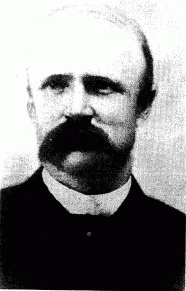 Thomas
Usher Butts
was born in Hancock County, Georgia, November
4, 1854, the son of James Irvin and Saleta Henry (Binion) Butts; James
Irvin Butts having been born in Hampton County, Virginia, April 13, 1800,
and Saletha Henry Butts in Hancock County, Georgia, March 2, 1815.
Thomas
Usher Butts
was born in Hancock County, Georgia, November
4, 1854, the son of James Irvin and Saleta Henry (Binion) Butts; James
Irvin Butts having been born in Hampton County, Virginia, April 13, 1800,
and Saletha Henry Butts in Hancock County, Georgia, March 2, 1815.
James Irvin Butts was the seventh
lineal descendant of James Butts, one of the first settlers of Jamestown,
Virginia.
Thomas Usher Butts was
married to Martha Leonora Beall in 1887 and to this union were born two
children: Mrs. Thomas Jefferson Kelley (Oline Beall Butts), and Thomas
Usher Butts, Jr.
The subject of this sketch departed
this life in Columbus, Georgia, on March 22, 1916.
He was graduated from
Mercer University, at Macon, Georgia, and at Eastman College, Poughkeepsie,
New York.
He moved from Hancock County, Georgia,
to Columbus in the fall of 1893 and became a member of the partnership
of Jones Bros. and Butts, who engaged in the retail lumber business. Two
years later this partnership was dissolved and he became a member of the
firm of Butts & Cooper who also engaged in the lumber business: Mr.
Cooper being the late J. T. Cooper. This firm was dissolved and Mr. F.
J. Dudley and Mr. Butts formed the corporation, Dudley-Butts Lumber Company.
Mr. Butts sold his stock i this company and then engaged in the wholesale
lumber business in Columbus under the name of Georgia Lumber Company,
he being the sole proprietor. At the same time he established Butts Lumber
Company of Phenix, Alabama, this corporation having been charter in 1907.
He continued to conduct his wholesale lumber business in Columbus and his
retail business company through the last named corporation up to the time
of his death.
Mr. Butts was a business man
par excellence. It was his policy to give every customer a square deal,
and, at the same time he was always most considerate and generous. His
disposition was most cheerful and his manners were most engaging. Having
had exceptional education advantages, he knew the vale there of, and he
saw to it that his own children attended the best educational institutions
and he lived to see them well equipped for the battle of life
The writer of this
sketch was the neigbor, the intimate friend and the legal counsel of Mr.
Butts for many years, and it is his opinion that one would find it most
difficult to decide which the more to admire his ebullient spirit or his
industry, his sagacity or his fixedness of purpose, his good humor or his
rectitude in all business relations.
A history of Columbus,
Georgia : 1828-1928 ,Columbus, Ga.: Historical Pub. Co., c1929, 574 pgs.
Warren
A. Candler
educator, was born in Carroll county, Ga., Aug.
23, 1857; son of Samuel C. and Martha (Beall) Candler. He was graduated
from Emory college, Oxford, Ga., in 1875. In the same year he was received
on trial into the North Georgia conference of the Methodist Episcopal church,
south, and served on various circuits until 1881, when he was made presiding
elder of the Dahlonega district. He subsequently served as pastor of the
church at Sparta, Ga., and the old church of St. John's at Augusta. He
was appointed in July, 1886, associate editor of the Christian Advocate,
Nashville, the official organ of the Methodist Episcopal church, south,
and continued in that work until June. 1888, when he was elected to the
presidency of Emory college. He was a member of the general conference
of the church in 1886 and 1890, and a delegate to the ecumenical conference
of 1891. He was elected bishop in 1898. Emory college gave him the degree
D.D. in 1888, and LL. D., 1897. He is the author of "The History of Sunday
Schools," and "Christus Auctor" (1899). The Twentieth Century Biographical
Dictionary of Notable Americans: Volume II
Josiah
Carr
planter, Culverton, Hancock Co., Ga., is a North
Carolina, where he was born in Franklin county, May 9, 1828. Bereft of
his parents at a tender age, Col. Carr came to Hancock county, Ga., where
he found a protector in the person of an elder brother, James Carr. He
was one of a family of seven children: James; Willis; John and Robert E.,
deceased; Green B, planter, Hancock county; Samuel. lives in Hopkins county,
Tex., and Josiah. When Col. Carr came to manhood he found a wife in Miss
Susan B. Barksdale, who lived but a year, dying without issue. In 1868
he again married, Sarah E. Collins becoming his wife. This lady died Aug.
26, 1880, the mother of two sons: Robert Lee, who grew to manhood, a bright,
promising, youth, but was stricken with typhoid fever, and died Oct. 25,
1892, and John Henry, a manly youth, now living with his father. Col. Carr
served his state to the best of his ability during the civil war, but was
too feeble in health to stand service in the field. His plantation consists
of 3,000 acres of choice land, lying eight miles northeast of Sparta. He
still holds to democracy, and is a member of the Baptist church. Memoirs
of Georgia Volume 1 Historical Society of Georgia, 1895
Absolom H Chappell
Absolom H Chappell born 18 Dec 1801 Mount Zion,
Hancock Co Ga died 11 Dec 1878 Columbus, Muscogee, Ga. He married 1842
Loretta Rebecca "LoLo" Lamar born 1818 died
1905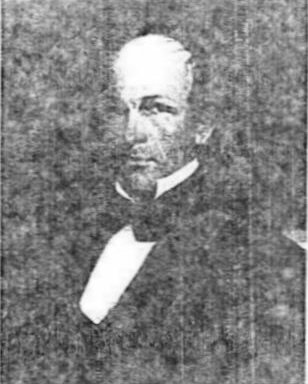
He was the child of Joseph Chappell
& Dorothy "Dolly" Harris
Grandchild of John C. Chappell Rev
Sol & Nancy Harrison, Absolem Harris Rev Sol & Clara Jeter
Great Grandson of Samuel Chappell &
Elizabeth Scott, Joseph Harrison Jr & Elizabeth Simmons, Benjamin Harris
Rev Sol & Faithy Smith, Joseph Jeter
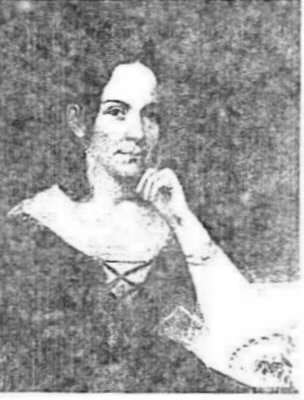 Loretta
was the child of Jeremiah Lamar & Rebecca Lamar Grandchild of John
Lamar Rev Sol & Lucy Appling, Thomas Lamar Rev Sol & Catherine
Reynolds
Loretta
was the child of Jeremiah Lamar & Rebecca Lamar Grandchild of John
Lamar Rev Sol & Lucy Appling, Thomas Lamar Rev Sol & Catherine
Reynolds
Great Grandchild of John Lamar &
Rachel Lamar, John C Appling & Martha Grubb, John Lamar
& Rachel Lamar-again-
Children:
Rebecca Dorothy 9 Oct 1843
Mary Amelia Louisa 3 Jul 1845
John Lamar 5 Jan 1847
Joseph Harris 18 Oct 1849
Thomas Jefferson 29 Nov 1851
Lucius Henry 27 Dec 1853
Rebecca died 18 Sep 1915 Portsmouth, Va.
She married 4 Sep 1873 Trinity Meth. Church James Hodges Toomer born
30 Apr 1834 Portsmouth,died 22 Jun 1915 same.
Mary died 15 Feb 1849 Bibb Co Ga
John died 20 Feb 1906 St Petersburg, Fl
He was a merchant in Memphis Tn.
Joseph died 6 Apr 1906 Columbus, Muscogee,
Ga He was a College President.
A Prominent educator of George.
Founding President of Georigia Normal &
& Industrial College 1890-1905 later Georgia State College for Women,
now Georgia College & State University, Milledgeville.[1999, Sibley
Jennings]
J. HARRIS CHAPPELL President of the Georgia
Normal and Industrial college, Milledgeville, Baldwin Co., was born near
Macon, Bibb Co. Ga, Oct. 18, 1849. When eight years old his father moved
to Columbus, Ga. where he received his primary education. Later, in 1869-70,
he attended the university of Virginia. Soon after leaving the university
he began teaching school and filling engagements in Clinton, Jones Co.,
and in other small country towns until 1877, when he located at his old
home in Columbus, where he remained seven yes. In 1884 he was elected principal
of the State normal school. Jacksonville, Ala., which he held two years
and was re-elected, but he declined because of the earnest and urgent solicitations
of leading citizens of Columbus. Ga. to return to that city and establish
a high grade girls' school. In response to this urgent solicitation he
went to Columbus and opened the school. He met with phenomenal success,
the attendance soon reaching 150 pupils, demanding a faculty of ten teachers.
He was principal- equivalent to a presidency - of this school until 1891,
when he retired to accept his present position. He was elected secretary
of the Georgia State Teachers' association in 1887, and served one year,
and in 1888 he was elected president. For a number of times he has been
chosen or appointed by the association as an essayist - unfailingly meeting
every expectation. As a practical educator, and one commanding the fullest
confidence of the public as such, President Chappell doubtless has equals,
but he has few, if any, superiors.
President Chappell was married in 1883 to
Carrie, daughter of the late G. H. Brown, of Madison, Ga., for many years
president of the Madison female college. She died childless in 1886, and
in 1891, he contracted a second marriage with Etta, daughter of Dr. J.
Kincaid, Rome, Ga., by whom he has had two children- Calmese, deceased,
and Cornelia.Memoirs of Georgia Volume 1Historical Society of Georgia,
1895
Thomas -a Prominant Attorney- died
8 May 1910 Columbus, Muscoogee, Ga
The Marion County Patriot
Friday, April 27, 1888
Page Three
Personals
The following visiting attorneys attended
court this week: Americus – J.C. Mathews, Edgar Hinton, J.S. McCorkle,
H.H. Lumpkin, W.C. Simmons, E.A. Hawkins. Columbus – Grigsby E. Thomas,
Sam Hatcher, T.J. Chappell, Cary Thornton, Lee Mchester. Talbotton – L.H.
Worrill, J.M. Mathews, Capt. Henry Persons, Roland Willis. Ellaville –
W.H. McCrory.
He was a prominent lawyer in Columbus, Muscoogee,
Ga and alive when Vol I Memoirs of Ga was written Atlanta 1895.He was the
author of text books.
Representative and State Senator, "a lawyer
of pronounced ability." (Callaway)
The Marion County Patriot, No. 45
November 7, 1902
Page Five
Senator McMichael
Senator E.M. McMichael, of the Twenty-Fourth
district, is one of the youngest and most popular members of the upper
branch of the legislature. He lives at Buena Vista, Marion County, and
succeeds Hon. Thomas J. Chappell, of Columbus.He is greatly interested
in improving the public school system of the state. President Howell has
recognized his ability in educational affairs by
appointing him chairman of the committee
on the University of Georgia. -
Atlanta News
The Marion County Patriot, No. 45
November 7, 1902
Page Five
Local Paragraphs
Senator McMichael has been quite liberally
honored in the committee work of the senate. He is chairman of the committee
on the University of Georgia, vice chairman on education and public schools
committee and is a member of the engrossing committee, special judiciary
committee, manufacturers committee, military committee, penitentiary committee
and committee on railroads.
Senator McMichael
The Marion County Patriot
Friday, November 7, 1902
Page Five
Senator E.M. McMichael, of the Twenty-fourth
district, is one of the youngest and most popular members of the upper
branch of the legislature. He lives at Buena Vista, Marion County, and
succeeds Hon. Thomas J. Chappell, of Columbus. He is greatly interested
in improving the public school system of the state. President Howell has
recognized his ability in educational
affairs by appointing him chairman of the
committee on University of Georgia. – Atlanta News.
Lucius died 14 Nov 1928. He married
Cynthia Kent Hart born 1872 died1948. They had 7 children.
The Lamar, Chappell, Harris, McMichael
etc. lines are mine
I am not a direct desc. of Absolom.
Ms.
Gerry Hill
http://deepsouthernroots.familytreeguide.com/
http://www.webspawner.com/users/gerryinga/index.html
submitted and copyright 2006 by Gerry
Hill
William
Nathaniel Coleman
planter, merchant, stockman and fruit grower,
Northern, Hancock Co., Ga. is a type of the vigorous and successful young
man of the day. Mr. Coleman is the son of Richard and Rebecca (Thomas)
Coleman, and was born in Nottaway county, Va., April 3, 1849. His father
was a prosperous planter of that county, but dying early, left Mr. Coleman
at fifteen years of age to fight life's battles for himself and a younger
sister. The property was left in such a shape as to give him little assistance.
Securing a clerkship at the country store of Co. J. W. Harper at the insignificant
salary of $50 per year and board, he soon made himself a necessity by diligent
and faithful service. He remained with Col. Harper three years, receiving
an increase in compensation each year. In January, 170, the lad concluded
to try his fortunes in the south, and arriving at Augusta secured a position
in the wholesale grocery house of Z. McCord. The following year he
came to Hancock county, where he engaged with an uncle, H. W. Coleman,
who was a merchant and planter on the Ogeechee river. A year was spent
with him, a few months with A. S. Bass, a merchant at Devereaux, and three
years with D. A. Jewell & Co., at Jewells, and then Mr. Coleman felt
equipped for business of his own. In company with a brother-in-law, J.
E. Medlock, and Mr. G. W. Bass, the form of Medlock, Bass & Co. began
business at Jewells, and continued successfully for some three years. Mr.
Bass then sold his interest to Mr. Coleman, who, after two years' successful
continuance of the business, sold to his partner, and began farming at
the point where he now resides, seven miles east of Sparta. He began on
a limited scale, but has each year added to his possessions, until he has
a little community of his own. A comfortable and commodious dwelling stands
on one side of the road, among shrubbery and flowers of every variety.
On the opposite side is a large gin house, with the latest improved machinery,
and a barn in which can be found thorough-bred Jersey cattle, thoroughbred
horses, and a large store building, filled with a choice stocks of goods,
a carriage and blacksmith shop, and best of all, a neat little school-house
and church. These buildings are all comparatively new and present a fine
appearance to the traveler's eye. Mr. Coleman has a fine plantation of
900 acres, and a magnificent bearing peach orchard of 10,000 trees. he
is too busy to engage in politics, but is a stanch democrat. he and his
family are members of the Methodist church, to which he is most liberal
in donations. On Jan. 28, 1878, Mr. Coleman and Willie, daughter of James
H. Middlebrooks, began their married life. They are the parents of four
children: Rebecca, died in infancy; Hawley, a bright lad of eleven years;
Virginia, nine, and Herbert, four. Mr. and Mrs. Coleman deserve and receive
the respect of a large circle of friends, whom they delight to entertain
and honor. Memoirs of Georgia Volume 1 Historical
Society of Georgia, 1895
Walter
Terry Colquitt
(father of Alfred Holt Colquitt), a Representative
and a Senator from Georgia; born in Halifax County, Va., December 27, 1799;
moved with his parents to Mount Zion, Carroll County, Ga.; attended the
common schools and Princeton College; studied law; was admitted to the
bar in 1820 and commenced practice in Sparta, Hancock County, Ga.; moved
to Cowpens, Ga.; elected judge of the Chattahoochee circuit in 1826 and
reelected in 1829; was licensed a Methodist preacher in 1827; member of
the State senate in 1834 and 1837; elected as a State Rights Whig to the
Twenty-sixth Congress and served from March 4, 1839, to July 21, 1840,
when he resigned, having refused to support General Harrison for President;
elected as a Van Buren Democrat to the Twenty-seventh Congress to fill
in part vacancies caused by the resignations of Julius C. Alford, William
C. Dawson, and Eugenius A. Nisbet, and served from January 3, 1842, to
March 3, 1843; elected to the United States Senate and served from March
4, 1843, until his resignation in February 1848; member of the Nashville
convention in 1850; died in Macon, Ga., May 7, 1855; interment in Linnwood
Cemetery, Columbus, Ga. Biographical Directory of the American Congress,
1774-1949
senator, was born in Halifax county, Va.,
Dec. 27, 1799; son of Henry and Nancy (Holt) Colquitt. He was educated
at the schools of Hancock county, Ga., whither his family had removed in
his infancy, and he attended the College of New Jersey for a time. In 1820
he was admitted to the bar at Milledgeville, Ga., and began to practise
at Sparta, later removing to Columbus, Ga. Late in 1820 he was chosen brigadier-general
of militia. He was licensed a Methodist preacher in 1827. He was circuit
judge, 1826-32, presiding over the first court held in Columbus; and in
1834 he was elected to the Georgia senate, being returned in 1837. In 1838
he was elected a representative in the 26th congress as a State Rights
Whig, resigned his seat in July, 1840, having transferred his allegiance
to the Democratic party, and was elected to the 27th congress, serving
from February, 1842, to March, 1843. He was elected a U.S. senator in 1842
and resigned in February, 1848, Herschel V. Johnson completing his term.
He was a delegate to the Nashville convention of 1850. He was married first,
Feb. 23, 1823, to Nancy H., daughter of the Hon. Joseph Lane; secondly
in 1841, to Mrs. Alphea B. (Todd) Fauntleroy, and thirdly in 1842, to Harriet
W., daughter of Luke Ross. He died at Macon, Ga., May 7, 1855.The Twentieth
Century Biographical Dictionary of Notable Americans:
Mark Anthony Cooper
Link
Addition:
He married 21 Jan 1826 Sopronia Randle born
28 Jun 1801 died 6 Feb 1881
His parents were Thomas Cooper III &
Judith Harvey
Grandparents Thomas Cooper Jr Rev
Sol and Sarah Clark Anthony
Great-Grandparents Thomas Cooper Sr.
Joseph Anthony Rev. Sol. & Elizabeth
Ann Clark
more -
Ms.
Gerry Hill
http://deepsouthernroots.familytreeguide.com/
http://www.webspawner.com/users/gerryinga/index.html
submitted and copyright 2006 by Gerry
Hill
Joel
Crawford
a Representative from Georgia; born in Columbia
County, Ga.; June 15, 1783; completed preparatory studies; studied law
at the Litchfield Law School; was admitted to the bar and commenced practice
in Sparta in 1808; moved to Milledgeville, Ga., in 1811; served in the
war against the Creek Indians as second lieutenant and aide-de-camp to
Brigadier General Floyd in 1813 and 1814; resumed the practice of law in
Milledgeville; member of the State house of representatives 1814-1817;
elected as a Democrat to the Fifteenth and Sixteenth Congress (March 4,
1817-March 3, 1821); returned to Sparta, Hancock County, in 1828; member
of the State senate in 1827 and 1828; appointed a commissioner to run the
boundary line between Alabama and Georgia in 1826; unsuccessful candidate
for Governor of Georgia in 1828 and 1831; delegate to the International
Improvement Convention in 1831; elected in 1837 a State commissioner to
locate and construct the Western & Atlantic Railroad; died near Blakely,
Early County, Ga., April 5, 1858; interment in the family burying ground
on his plantation in Early County, Ga. Biographical Directory of the
American Congress, 1774-1949 Biographies page 1032
representative, was born in Columbia county,
Ga., June 15, 1783. He was educated in the school of Dr. David Bush; studied
law under Nicholas Ware of Augusta, and at the Litchfield (Conn.) law school;
was admitted to the bar in 1808, and practised in Milledgeville, Go. He
was an aid to General Floyd in the Creek war, 1813-14, with the rank of
major. He was a representative in the Georgia legislature, 1814-17, and
a Democratic representative in the 15th and 16th congresses, 1817-21. He
removed in 1828 to Sparta, Hancock county, and served in the state senate
three consecutive years. He was a member of the commission to fix the boundary
between Alabama and Georgia in 1826; an unsuccessful candidate for governor
of Georgia in 1828 and again in 1831, and a commissioner to represent the
state on the board of directors of the Western and Atlantic railroad, 1837.
He was elected a member of the Georgia historical society in 1842. He died
in Early county, Ga., April 5, 1858. The Twentieth Century Biographical
Dictionary of Notable Americans: Volume III
John
L. Culver
planter, Culverton, Hancock Co., Ga., is
a worthy scion of one of the oldest and most prominent families in middle
Georgia. His grandfather, George Culver, together with two brothers, came
to the state from the Chesapeake bay country in Maryland soon after the
revolutionary war, and settled in Hancock county. Here he married Elizabeth
Ellis, who bore him a large family of sons and daughters. Hardy C., one
of these sons, the father of John L., was born in 1800, and about 1824
married Ann L. Latimer, to whom were born eleven children, as follows:
William H., merchant, Culverton; Henry H., deceased; John L., Ann Elizabeth,
deceased wife of Daniel Connell, Culverton; Mary J., wife of Capt. J. W.
Moore, Culverton; Thomas H., a lieutenant of Company K, Fifteenth Georgia
regiment, killed at the battle of the Wilderness; German P., and Benjamin
C., planters, Culverton; Robert M, deceased in childhood; Edward H., private
in Company K, Fifteenth Georgia regiment, killed at Gettysburg, and Amazon
B., who died in girlhood. Both parents of this family died in 1865. Hardy
C. Culver was a man of wonderful energy, fine business judgment, and was
held in high esteem by his fellow-citizens. He founded the town of Culverton,
and was always foremost in every work that promised well for the public
good. He gave liberally to all educational enterprises, and as a Methodist
was untiring in his efforts for the advancement of that denomination, being
an intimate friend of and co-worker with the late Bishop George F. Pierce.
In politics he was a whig, and, though not at all fond of political life,
he, by reason of his peculiar fitness, was forced to yield to the solicitations
of friends, and represented his county in the legislature a number of terns,
frequently drawing the support of democrats because of his just and conservative
views. John L. Culver was born Dec. 26, 1829. he was raised on a plantation
and given a good common school education. In July, 1861, he entered the
Confederate service as captain of Company K, Fifteenth Georgia regiment,
and saw service in Virginia until 1863. On the advice of his physician
he resigned his commission and returned home to recuperate his failing
health. When Sherman invaded Georgia he again became a soldier, this time
as special escort to Gen. Gustavus Smith of the state troops, in whose
service he remained to the end of the war. Mr. Culver's life has been devoted
to agricultural pursuits. As a planter he has no superior in the county,
and combines with a scientific knowledge of that honorable pursuit, an
aptitude for business and public life which has won for him a state-wide
reputation. In politics he is a stanch democrat and did fine service just
after the war in wrestling the county from the rule of incompetent negroes
and rascally carpet-baggers. He represented his party in the lower house
in the sessions of 1872-73-74 and 1875., and in 1890 was elected to represent
the Twentieth senatorial district in the general assembly. He is at present
chairman of the democratic executive committee, and president of
the democratic party organization in Hancock county. The village of Culverton
was incorporated in 1890, and he has since served as mayor. As a steward
in the Methodist church and a member of the masonic fraternity Mr. Culver
is a useful and popular adjunct of the community in which he resides. His
marriage occurred in Glascock county, Ga, Nov. 12, 1850, his wife having
been Miss Mary L;, daughter of Louis Cheely. Four children were raised
to maturity: Mary M., deceased wife of R. H. Moore, Culverton; Anna M.,
at home; Louis E., wholesale hardware merchant, Macon, Ga., and B. Louvill,
wife of J. E. Kidd, Milledgeville, Ga. Memoirs of Georgia
Volume 1 Historical Society of Georgia, 1895
David
Dickson
Deceased. Nothing so touches the heart of the
true Georgian with sadness as does the contemplation of the rapidly decaying
old plantation house of ante-bellum days, and its hoary-headed and tottering
inmate, both soon to be numbered among "the things that were, and are not."
They speak of proud days, days when the "planting element" dominated
in the realms of politics and society, and read the law to all other occupations.
This element was especially strong in Hancock county, where just before
the war were some of the largest and finest plantations in the state. Possibly
the largest and finest of these was that of the gentleman above named,
he at one time having cultivated a body of some 30,000 acres. A drive of
twelve miles southeast of Sparta will bring the traveler to the old Dickson
plantation, where he will find the spacious house and outbuildings still
standing though the "hand which held the plow" lies nerveless and still,
under the sod it once cultivated. David Dickson was born in Hancock county,
Ga, July 4, 1809, the son of Thomas and Elizabeth Dickson, an humble but
honest parentage. Like most of the early settlers, they were dependent
on the efforts of their own hands for their daily bread, and thus brought
their children up in the best agricultural training school ever yet discovered.
As David approached manhood, the period in which slave labour was most
profitable dawned upon the south, and for the next two decades held
sway. Beginning with moderate means he amassed property rapidly, and during
the entire latter half of his life was probably the wealthiest man in his
county. Some of his methods were peculiarly his own. It is said that he
was phenomenally kind in the treatment of his slaves, and such was his
influence over them that he had no use for an overseer. He was not an educated
man so far as book knowledge is concerned, but was endowed with more than
ordinary gifts of mind in the sphere in which he laborerd. He knew the
productive qualities of every foot of his land, and could tell to a bushel
or a bale just what each plat ought to yield. Thus, when free labor took
the place of slave, he allotted each his portion in the spring-time, and
told him just how much it would yield if properly cultivated. His rents
were collected on those figures, of course allowing for the season, and
it is said had very few failures as a consequence. Mr. Dickson was liberal
with his means toward all worthy pubic enterprises and in matters pertaining
to education and religion; and though he favored no particular denomination,
his moral character was such as to command the respect of his associates.
He never used tobacco or liquor in any fore, and was very chaste and careful
in his language. He retained his powers, both physical and mental, to the
last, dying suddenly within an hour on Feb. 13, 1885, leaving his
entire property to a former favorite female slave, who at her death, willed
the same to her two sons, Julian H. and Charles G., the present owners
of the large property. Memoirs of Georgia Volume
1 Historical Society of Georgia, 1895
William S. Dickson
Planter, Sparta, Hancock county, Ga., is a prosperous
planter living five miles southeast of Sparta. He was born in the county
Sept. 25, 1839, and is the son of James M. and Margaret A. (Crawford) Dickson.
The Dickson family history available at this time dates back to William's
grandfather, Curry Dickson, who grew to manhood and passed his life in
Hancock county. No data as to his birth and antecedents could be obtained.
He married Elizabeth Shy, a name familiar to all Georgians as on of the
highest respectability, and from their union sprang three boys and one
girl: James M., W.S., D.W., and Emily Francis, now Mrs. Thomas Jordan,
Craig county, Tex. James M. is the father of William S., and is still living
near him at the advanced age of eighty years. He is exceedingly well-preserved
and still looks after his little farm as in his younger days. He married
in 1838, and has seen eight children grow to maturity, as follows: William
S., the subject of this sketch; James C., David W. and Green L., successful
planters of the county; Eliza J., single; Sarah, wife of B. J. Clark; Georgia,
single; Emily F., wife of James M. Dickson, also planters of Hancock county.
William S. has always resided in the county of his nativity. When the war
broke out he enlisted early as a private in Company K, Fifteenth Georgia
regiment, and did his duty manfully till the surrender The regiment arrived
too late to be of service in 1861, but from the opening of the campaign
in 1862 to the surrender, saw plenty of hard fighting. While Mr. Dickson
was in the ranks he participated in the seven days' battle around Richmond,
Fairfax court house, Second Manassas and at Gettysburg. In the latter battle
he was severely wounded in the left shoulder, disabling him to such an
extent as to preclude his carrying a musket in the ranks, and on his return
to the army he was therefore detailed for service on the wagon train. He
was married in Hancock county, Dec. 24, 1865, to Rebecca, daughter of John
A. Kelly. Mr. Dickson is a deacon in the Baptist church, and a most uncompromising
democrat in politics. His democracy is of that type that finds no sacrifice
too great for the advancements of the interests of the party, and much
credit is due him for the solid front which it has been enabled to present
in the county to the advancing hosts of populists. Memoirs
of Georgia Volume 1 Historical Society of Georgia, 1895
Charles
Wilds DuBose
Charles Wilds Du Bose (deceased), lawyer and
jurist, was born in Darlington district, S.C.., on Sept. 24, 1825. His
family were French Huguenots, their ancestors having emigrated from France
to the then province of South Carolina upon the revocation of the edict
of Nantes in the seventeenth century. His grandfather, Elias Du Bose,
held a commission and bore a conspicuous part in the revolutionary war.
His father, John Wilds Du Bose-named in honor of his maternal uncle, Judge
Samuel Wilds, a highly-distingquished jurist of South Carolina - married
his cousin, Elizabeth Roberts, the daughter of Dr. John Roberts, a Baptist
clergyman living in Cheraw's district: and Charles was their only surviving
son. While still in infancy his mother died, and with the boy Mr. Du Bose
left the state of his nativity and sought a new home on the St. Mary's
river, Florida, where he purchased a large tract of land and spent
the remainder of his life as a planter. When Charles was about five years
of age his father brought to his home a second wife, the daughter of a
relative who lived on the "High point of the Cumberland," Miss Mary K.
Miller, first cousin to his wife Elizabeth. This gentle lady proved
to be a faithful stepmother to the lonely, sensitive child, whose heart
was, however, bound up in the father, to whom he was passionately attached,
but who died when the boy was just verging on manhood. This second marriage
was blessed with sons and daughters, and among them the thoughtful lad
grew up tenderly cared for by the mother, to whom to the end of her life
he was a true, unselfish elder son. His education was directed by the Rev.
Dr. Baird, a Presbyterian clergyman, and noted instructor of boys at the
academy in "Old St. Mary;" his uncertain health, deterring his father from
sending him away from home. At sixteen the studious boy grew weary of the
monotony of plantation life and longed for other scenes. With high hope
in his young heart he left his father's sheltering arm and went to Augusta
to begin the study of law, in the office of his relative, the Hon. Andrew
J. Miller. Into the family of his stepmother's brother he was admitted
as a son, remaining there until he was made a member of the bar of Georgia,
by special act of the legislature, at nineteen years of age. Advised by
Mr. Miller, he immediately went to Sparta in Hancock county, where he went
into practice with Hon. Eli H. Baxter. Upon the election of his co-partner
to the judgeship of the northern circuit he formed a second connection
with the Hon. Linton Stephens, which was dissolved in 1860 by the latter's
appointment to a seat on the supreme bench. Between this two me, totally
dissimilar in temperament, there grew a lasting and tender friendship.
Perhaps, more than all else, to gratify his friends, Mr. Du Bose accepted
the clerkship of the supreme court, holding that position through many
difficulties until removed, under reconstruction influences, in 1868. Very
early in the war he and Linton Stephens formed a company of infantry called
the "Confederate Guards." Upon the promotion of Capt. Stephens to the rank
of major the command devolved upon him, but his friends, particularly Hon.
Alex. H. Stephens, objected so strongly to his going to the front on account
of his delicate health, and the imperative need for his presence at home,
that he reluctantly consented to remain behind. This was a grief to him
while the war lasted, so much that when the governor made his last call
for volunteers he presented himself at once, as a private soldier in the
camp at Atlanta, only to be prostrated with camp fever. Learning this the
governor sent his carriage, brought him to the city, and upon his positive
refusal to return home, gave him a position on his personal staff. From
1848 to 1860 he held the office of ordinary of Hancock county by continuous
elections; and during the war he was twice elected to the lower branch
of the general assembly, serving in all six years. It was during the latter
part of his service as legislator that he succeeded in getting through
the house the bill introduced by Hon. Andrew J. Miller, but which he could
never get further than the senate. This was the bill called "The Woman's
Bill." now a law, giving to every married woman her own property. For that
service the women of Georgia have cause to be forever grateful to Col.
Du Bose's energy and perseverance. He was a member of the succession convention
at Milledgeville. In 1877 he was again elected to a similar convention
which framed our present constitution. From that time he declined all offices,
even modestly refusing to listen to tempting offers of judicial preferment,
devoting his energies solely to his profession. At last, however, he yielded
to the solicitations of friends, and consented to represent the Twentieth
senatorial district. During this term occurred the famous impeachment trials
of the comptroller and state treasurer, he being one of the small minority
whose votes acquitted Mr. Renfroe. At this term also his son, Andrew Miller
Du Bose, represented his county in the lower house, his colleagues being
the Hon. William J. Northen, who afterward served two terms as governor
of the state. It was at the earnest solicitation of his friend, Col. Du
Bose, that Mr. Northen then, for the first time, made his appearance in
official life. In each of these varied public trusts Col. Du Bose proved
himself able, conscientious and faithful. In 1848 he married Miss Catherine
Anne, eldest daughter of Rev. Wm. Richards, a faithful and devoted clergyman
of the Baptist denomination, who came with his family from England while
she was very young. Her education began in the northern states, was continued
under the care of the beloved Mrs. Edgerton (afterward Mrs. Orme of Milledgeville),
at her famous school at Midway, Ga. This union was particularly fortunate,
congeniality of tastes and perfect understanding giving to their home life
an unusual degree of wedded happiness. Mrs. Du Bose early won distinction
in the literary world as a writer of prose and verse. She has enduring
mention in many works, referring to "Female Writers of the South/" Her
little book, The Pastor's Household, and many poems and periodical contributions
attracted widespread attention. Her entire family seems to have been gifted
with the literary faculty, notably her oldest brother. Dr. Wm. C. Richards,
of Chicago, who won eminence as poet, scientist, lecturer and divine. Mr.
T. Addison Richards of New York city, a distinguished landscape artist
and writer, who held the responsible position of corresponding secretary
of the National Academy of Design for forty years, Also her sister, Mrs.
Amelia S. Williams of Tennessee, who wields a ready and facile pen in prose
and verse. The children of this happily married pair have all grown to
man's estate, in honor. The eldest was Charles S. Du Bose of Warrenton,
Ga., whose death at the untimely age of thirty-two cut short a life of
great usefulness and rare promise, and inflicted a blow to his father's
heart from which he never fully recovered. This youth quickly rose to eminence
at the bar, and served the state twice as legislator, and afterward in
the state senate, from which his failing health compelled him to resign.
Hon. Andrew Miller Du Bose, his second son, has represented his county
in the lower house, and still practices law in his father's old office
in Sparta, Ga. His two younger sons are Dr. Wm. Richards Du Bose, an eminent
and valued surgeon in the United States navy, and Dr. George Pierce Du
Bose, who holds a responsible and honorable position in the medical department
at Washington. D.C. To each of his sons it was his pride and happiness
to give every advantage of education, building firmly upon the solid foundation
laid by their devoted mother. Their success in life amply repaid his self-sacrificing
efforts. His work thus nobly done., Col. Du Bose departed this life on
Oct. 22, 1890, having just completed his sixty-fifth year. He was a member
of the Presbyterian church, and counted one of the most useful citizens
of his county and state. His sturdy integrity and unwavering honest, his
steadfast friendship and useful devotion to his wife and children, his
gentle, courteous demeanour, and the graces that ever adorned his practical
Christian life secured for him the admiration, esteem, reverence and love
of everyone who knew him. His wife stills survives him, in the beautiful
home he mad for her, blest by the loving care of her sons, and their accomplished
wives, and enjoying the competence won for her by his professional energy
and zeal.
Kate
A./Catherine Ann Du Bose
This Sparta poetess
was born in Hook Norton, Oxfordshire, England, September 19, 1826,
the eldest daughter of Rev. William Richards, a Baptist clergyman,
of Beaufort District, S. C. Shortly after her birth, the family came
to the United States, settling first in Hudson, N.Y. and then in Georgia.
Later the Richards moved back to South Carolina. She was a sister of the
artist, Thomas
Addison Richards of New York Kate attended schools in Northern
cities and Midway, Ga.and for some years was a teacher in Georgia.
On June 20, 1848, she
married to Charles Wilds Du Bose, Esq. a lawyer in Sparta, Georgia, who
was born in South Carolina. The Du Bose family lived on a plantation
near Mayfield before moving to Boland Street in Sparta in 1856. Kate had
4 sons: Charles S. Du Bose, lawyer in Warrenton, 1849-1881, married to
Louisa Derrelle Wellborn 1848-1934, buried Sparta City Cemetery;
Colonel Andrew Miller Du Bose, planter in Hancock County, 1851-1914, buried
Sparta City Cemetery; Dr. William R. Du Bose, U.S. navy surgeon; and Dr.
George P. Du Bose, medical examiner in the pension office in Washington
D.C.
Her work was published in
journals and magazines, generally under the nom de plume of "Leila Cameron."
Some of her best poems appeared in the "Southern Literary Gazette,"
(Charleston S.C.) Her brother Rev. William C. Edwards was the editor. In
the Orion Magazine of Georgia she published "Wachulla". In 1858 she
published "The Pastor's Household", a prose story for the young. She completed
a second story, called "The Elliot Family", but the manuscript was destroyed
by a fire in New York.
Charles Du Bose born Sept. 24 1825
died Oct. 20 1890. He was a member of the Ga Legislature (1861-66), Ga
Senate 1878-81), and clerk of Ga Supreme Court (1860-68).
Kate, a member of the Presbyterian
faith, died at her home in Sparta May 25, 1906 at the age of 80.
Sources: Critical dictionary
of English literature, and British and American authors, living and deceased,
from the earliest accounts to the middle of the nineteenth century. Containing
thirty thousand biographies and literary notices, with forty indexes of
subjects. By S. Austin Allibone. Publication date: 1859-71. Author:
Raymond, Ida; Southland writers. Biographical and critical sketches
of the living female writers of the South. With extracts from their writings.
By Ida Raymond. 1870. Title: Appletons' cyclopædia of American biography;
1887-89. 1906 Obituary Atlanta Constitution. Census Records; Cemetery
Records
Henry
Graybill
Henry Graybill, Esq., aged 82 years. he was
born in Lancaster, (Penn.,) but removed to South Carolina before the Revolutionary
War, and afterwards settled in Georgia, where he lived forty-two years.
He was a conspicuous and active man during the contest which obtained our
Independence, and filled with credit to himself and county the important
offices of surveyor, clerk of the court &c., and was four times elected
by the Legislature of this state one of the electors of President and Vice-President.
He has been a member of the Baptist Church for fifty years, and of the
Masonic fraternity since the first establishment of regular Lodges in our
State. He substained through a long life the most unblemished character.
White, George. Historical
Collections of Georgia. New York: Pudney & Russell, Publishers, 1854.
Additonal information:
"Georgia Revolutionary War Soldiers Graves"
929.34:
1776-The tombstone states "Lieut. SC Troop
-- Rev. War".
1786-He joined the Powelton Baptist church(Greene
now Hancock Co) as a charter member
1786-Jan. 11-SOME GEORGIA COUNTY RECORDS-
Lucas page 163
page 26 State of Ga-Greene Co. Personally
came before me HENRY GRAYBILL one of the Justices assigned to
keep the peace for the said County BENJAMIN
THOMPSON and made oath on the Holy Gospen of Almighty GOd
that he was present and saw the within named
JOHN HARVEY sign seal and deliver for the uses within mentined
the within deed and that he also saw WILLIAM
DICKSON subscribe his name thereto as a witness. Signed BENJ.
THOMPSON. Sworn on befoe me the 11th day
of January. HEN. GRAYBILL, H.P. Deed from JOHN HARVEY & Wife
to James VEAZEY. Notatation in margin: "There
is a deed from HARVEY TO VEAZEY in this book. Two leaves
appear to be cut out of the original immediately
before this affidavit with a knift."
pages 29-30-Jan. 18- JOHN LAMAR of "state
and county aforesaid" to MICHAEL GILBERT of same (Greene Co)
for 100 pds. specie 250 acres in Wilkes
Co. but now taken into Greene, bounded on all sides by JOSEPH
ANTHONY'S lands and SMITH'S survey, originally
granted the said LAMAR by Gov. Houston. Signed JOHN LAMAR
JUNR. Wit. Hen. GRAYBILL, J.P. (John was
nephew of Sr.)
1777-Mar.30-OME GEORGIA COUNTY RECORDS-Lucas
page 179
HENRY GRAYBILL & MARY his wife of Greene
Co to JARED BURCH of same, for 75 pds.specie, 150 acres adj.
WILLIAM STUART, PETER JACKSON; part of two
400 acre tracts originally granted the said GRAYBILL.
Signed:: HEN. GRAYBILL, MARY (X) GRAYBILL,
Wit. BENJA. THOMPSON, JAMES ORRICK, N. JERNIGAN
1788 May 8, pages 158-9 JOHN LAMAR of Greene
to EDMOND KNOWLES of same, planter for 20 lbs specie,
125 acres on the waters of Shoulderbone
Creek adj. WILLIAM MADDUX, THOS. LAMAR, part of a
250 acres tract originally granted the said
LAMAR 15 Mar 1785 Signed John Wit. THOS. LAMAR,
HILLERY PHILLIPS, HENRY GRAYBILL JP.
1788-Nov. 20 SOME GEORGIA COUNTY RECORDS-Lucas
page 179
JOSIAH CARTER (my ancestor) Of Greene Co.
to THOMAS GRACE of same for 100 pds. lawful money of Ga
200 acres in Greene formerly WIlkes CO granted
the said Carter 13 Oct 1785. Signed JOSIAH CARTER. WIt.
WELDON *H) OWSLEY, R. MIDDLETON JP, HENRY
GRAYBILL HP
1790-Jan 27-SOME GEORGIA COUNTY RECORDS-Lucas
page 167
Pages 62-63-JAMES WOOD to JOHN MILLER of
Greene Co for 250 pds. lawful money of Ga. 350 acres on a
branch of Beaverdam of Ogechee, bounded
N by JOHN BOYD, W by DOWDEL, S by MICAJAH WILLIAMSON and
WILLIAM TYLER, SW by HENRY GRAYBILL and
JAMES HARVEY, WELDON HOUSBY, SIgned: JAMES WOOD. Wit.
BENJAMIN GILBERT, R. IDDLETON Reg. 21 apr
1792
1790-Jan. 27-SOME GEORGIA COUNTY RECORDS-Lucas
page 167
Page 64-SANDERS WALKER of Wilkes Co to JOSEPH
HOWARD of Greene CO for 00 pds. 287 1/2 acres in
Greene Co. on Rocky Creek, granted to DILL
SAP 31 Dec 1784 and conveyed to said WALKER 12 Dec 1785.
Signed SANDERS WALKER Wit. HEN. GRAYBILL
JP JNO SWEPSON Rec. 23 Apr 1892
1790-31 Jul- pages 385-386- (SOME GA CO
RECORDS) Josiah Carter and Mary Carter his wife of Wilkes to
Richard Lockheart of Greene, for 50 pds.
sterling, 200 acres on Hoopole Creek, bounded E. by Robert Harper,
all other sides vacant; granted said Carter
by Gov. 12 Sep 1784. Signed Josiah, Mary Wit. Henry Graybill JP
Wm Speir Reg.
1790-Charles County (MD) Gentry, Newman.
Page296:
" Jan 30 1617 JOHN BRUCE married Judith,
the widow of John Warren. Ch: CHARLES BRUCE, TOWNLEY BRUCE
the youngest, FRANCES BRUCE , ELIZABETH
BRUCE.
In 1790 a TOWNLEY BRUCE is enumerated in
the Georgia 1790 reconstructed census in Greene County. He
witnessed a deed dated 14 April 1787, recorded
in Deed Book 1, page 44. Thomas Heard of Greene Co to
Micajah Williamson of Wilkes Co, land adjoining
the Academy land on Richland Creek... Witnessed by Townley
Bruce, James Lamar Jr. and Henry Graybill
J.P.
1793-Hancock County Georgia Deeds, 1794-1802,
Page 374: 13th Dec 1793, Peter JACKSON and Susana, his wife,
of Greene County, Georgia to John Michael
and Samuel LAWRENCE, merchant, of same place for the sum of
five hundred pounds sterling for a tract
of land in Greene County on the waters of Powell's Creek south of
Ogeechee, containing two hudnred and twelve
acres, it being part of an eight hudnred and sixty five acre tract
of land granted to said Peter JACKSON on
10th Dec 1793, and bounded by HERNDON and HARVEY, by GRAYBILL,
by STEWART'S, and by MIDDLETON'S land. Wit.:
James ORRICK and Tunstall ROAN
1797- Hancock County Georgia Deeds, 1794-1802.
Page 454: 04 Sep 1797, Peter JACKSON of Greene County to
William JACKSON of Hancock County for the
sum of five hundred dollars for a tract of land in Hancock County on
the waters of Powell's Creek, containing
two hundred acres adjoining lands of James ORRICK, Jared BURCH and
John WEEK'S and Henry GRAYBILL'S land. Said
Peter JACKSON and Susannah, his wife, conveyed unto said
William JACKSON said land. Wit.: Ransom
HARWELL, J.P. and John CROWDER.
1798- Hancock County Georgia Deeds, 1794-1802,
Pages 213-214: 02 Jun 1798, Peter JACKSON of Greene
County, Georgia to Nathaniel BELL of Hancock
County, Georgia for the sum of one hudnred pounds sterling for a
tract of land contgaining 200 acres in Hancock
County, GA on the waters of Powell's Creek. Signed by Peter
JACKSON and Susana JACKSON. Wit.: GRAYBELL
(GRAYBILL), J. P. and Benjamin BATTLE. Reg.: 22 Jan 1799.
1801-Phillip Pool's will dated Sept 1801
in Hancock Co, Ga. lists as his daughter Mary Graybill. His other children
were Ephriam, Henry, James, Susannah Capps.
1820- Henry Graybill's will-Will Book L,
pp 7-11-Hancock CO Ga.
The will was dated 14 Jan 1820. It was probated
in 4 Nov 1822. The appraisal of his property was dated 5 Nov
1822., mentions his "beloved wife Polly
Graybill".
He was buried at Choice Cemetery-in rural
Hancock CO Ga near Devereaux- Henry Graybill's tombstone
disappeared from the Choice Cemetery Vandals
moved the tombstone to and turned up in Wilkinson Co GA --
descendants live there, so they placed the
marker in the Gordon City Cemetery.
On Saturday, January 10, 2004, at 2:00 PM
in historic Memory Hill Cemetery, Milledgeville, Georgia, there will be
the dedication of the replacement gravemarker
for Henry Graybill of PA, 1741-1822, who removed to SC and
then to GA -- his actual grave is in the
Choice Cemetery in Hancock Co, GA, but access is poor to the site, if not
impossible in rainy weather. This dedication
sponsored by the John Milledge Chapter, Sons of the American
Revolution, and the Nancy Hart Chapter,
Daughters of the American Revolution.
The new "pillow" marker made for Henry Graybill
and it has been placed in the Choice/Graybill Cemetery next
to Tully Choice (a Rev. Patriot).
William Harper, Rev. Patriot, also buried
this old, remote, very hard to find cemetery (road blocked by hunters'
locked gate). Wyatt Harper, War of 1812,
also buried there. There are many "sinks" with no markers except for
one apparent grave with rocks for head and
foot. A dedication ceremony will be held before too long for the new
marker for Henry, probably in historic Memory
Hill Cemetery, Milledgeville, due to the poor access and primitive
road to the Choice Cemetery. Placing it
was delayed due to trying to figure out which cemetery it should be in
and the Choice Cemetery is the one (there
is only one Choice Cemetery in Hancock County) and one goes thru
Devereaux to get there from Sparta, county
seat of Hancock Co.
"Georgia Revolutionary War Soldiers Graves"
929.34:
Henry Graybill (born; 1755--died 10-29-1822),
came from Lancaster Co, PA and served as a private under
General Elijah Clarke and received bounty
land for his services---Buried near Devereaux The tombstone states
"Lieut. SC Troop -- Rev. War".
Known Children of Henry Graybill-
Elizabeth married Henry Saunders Journigan
8 children-#2 Stephen Lawrence 30 Dec 1813 Putnam Co Ga
John 3 Mar 1791 Ga-3o Nov 1875 Smith Co
Tx married Nancy Ann Choice 7 children
Michael a 1791-bef Jan 1840 Baldwin Co Ga
married Judith One known child Jesse Goodwin Butts Graybill- to Tx.
Henry
Ms.
Gerry Hill
(Not my family, but good friends w/my John
Lamar & James Gray of Greene and Hancock-both Rev. Sol.)
http://deepsouthernroots.familytreeguide.com/
http://www.webspawner.com/users/gerryinga/index.html
submitted and copyright 2006 by Gerry
Hill
Henry
Richard Harris
Representative from Georgia; born in Sparta,
Hancock County, Ga., February 2, 1828; moved to Greenville, Meriwether
County, Ga., in 1833; attended Professor Beeman's School for Boys, Mount
Zion, Hancock County, Ga., and was graduated from Emory College at Oxford,
Ga., in 1847; member of the State constitutional convention in 1861; during
the Civil War served in the Confederate Army as colonel; elected as a Democrat
to the Forty-third, Forty-fourth, and Forty-fifth Congresses (March 4,
1873-March 3, 1879); unsuccessful candidate for reelection in 1878 to the
Forty-sixth Congress; elected to the Forty-ninth Congress (March 4, 1885-March
3, 1887); was not a candidate for renomination in 1886; appointed by President
Cleveland as Third Assistant Postmaster General of the United States and
served from April 1, 1887, to March 18, 1889; engaged in agricultural pursuits;
died in Odessadale, Meriwether County, Ga., October 15, 1909; interment
in Greenville Cemetery, Greenville, Ga. Biographical Directory of the
American Congress
James
M. Harris
planter, Hancock Co., Ga., is a representative
of an old and aristocratic family, which has for long years wielded a powerful
influence for good in Hancock county. Planters by occupation, and large
land owners, they united with an unsurpassed technical knowledge of farming,
a clever business judgement which kept them at the head of the wealthy
families of the county. Few people are better know or more familiarly known
than "Jim" Harris. he is a son of Peterson and Rebecca (Hurt) Harris, and
was born near where he now resides, Nov. 1, 1819. His parents had come
some years prior to this event from Maryland and settled on Shoulder Bone
creek, eight miles northwest of Sparta. Here a family of six sons were
born to them. The father died at a rather early age, and the mother married
and moved with all the children except James, to Alabama, where she passed
the remainder of her days. After his father's death James went to reside
with an uncle, Miles G. Harris, who acted as his guardian and by whom he
was reared. He was happily married Feb. 4, 1845, in Hancock county, to
Miss Elizabeth, daughter of Edwin Wiley, another of the old families of
the county. Mr. Harris has no children of his own, but adopted at
an early age, Moses W., a son of his wife's brother, Samuel H. Wiley, to
whom they have given all the attention which could have been bestowed on
one of their own flesh and blood. Moses W. was educated at the famous Mt.
Zion academy then presided over by WIlliam J. Northern, who has since filled
the gubernatorial chair with such honor; and at the university of Georgia,
which institution he was completed to leave before graduation because of
the serious illness of his father. From that time he gave his entire attention
to the management of the plantation, knowing that, as the only representative
of the family, the task would devolve upon him each year with greater weight
as he father's health continued to fail. In 1876 Moses W. Harris was joined
in marriage to Miss Lizzie H., a daughter of James T. Gardiner of Augusta,
and to the union there have been born the following: James M. Jr., Mattie
E, Sarah W., Henry B., Carrie H. Birdie, Elizabeth B. and mary S. An intimated
before, the Harris estate is one of the largest in the county, containing
5,000 acres more or less of choice plantation lands on Shoulder Bone creek.
For long years Mr. harris has given his personal attention to the cultivation
of these lands, and is only yielding ot the force of circumstances in relinquishing
the work to his son as age creeps upon him. The tastes of the family never
ran in the line of politics or public life in any form, and though Mr.
Harris has frequently been importuned to accept honored positions in county
and state, he has always refused. he has simply done his duty as a private
in the ranks of democracy. The Harris family has always been of the Presbyterian
faith, and James M. follows in the same pathway. Memoirs
of Georgia Volume 1Historical Society of Georgia, 1895
Memoirs of Georgia Volume
1Historical Society of Georgia, 1895
William
Anderson Harris
educator, was born in Augusta county, Va., July
17, 1827; son of Nathan and Ann Allan (Anderson) Harris, and a descendant
of Robert Harris, who emigrated from England about 1660, and settled in
Hanover county, Va. He was graduated at the Virginia military institute
in 1851, and was admitted to the practice of law. He removed to Sparta,
Ga., where he became principal of a young ladies' institute. He removed
to La Grange, Ga., in 1859, and accepted the presidency of La Grange Female
college. He resigned to accept the presidency of Martha Washington college,
Abington, Va., and at the close of the civil war he became president of
Wesleyan female institute, Stanton, Va. In 1892 he removed to Roanoke,
Va., and established the Virginia college for the higher education of women.
Randolph Macon college gave him the degree of D.D. in 1875. He died in
Roanoke,
Va., Sept. 2, 1895.
The Twentieth Century Biographical Dictionary of
Notable Americans: Volume V
James
A. Harley
Conspicuous among the old and reliable families
of Hancock county the name of Harley stands worthy of honorable mention.
Different members have won distinction in professional and literary circles,
and intermarried with other families equally as eminent, notably the Battles,
of lasting prominence throughout the state. The progenitor of this branch
of the family, William J. Harley, was a native of Barnwell district, S.C.
He was educated at a Baptist theological seminary, graduating in 1828 in
the class made famous by Drs. McIntosh, De Votie and other of scarcely
less prominence in religious circles. Serving the Master in pulpits of
South Carolina until middle age, he came to Hancock county, where several
years before he had met, while attending a Baptist association, Miss Mary
L. Battle. They were married in 1843, and thus began a life of connubial
bliss unmarred by a single unkind act or word during its continuance. They
made Hancock county their place of residence during all their married life,
and were the parents of a most interesting and cultured family: James A.;
Ella A. (deceased), at fourteen years of age; Mamie B., and Anna S., teachers;
W. I.,, a prominent and successful planter and stockman of Hancock county;
and Reuben B. Rev. Harley continued in the Baptist ministry until 1870,
the date of his death. he was a man whose labors were wonderfully blessed
in building up his denomination throughout the state. Mrs. Harley was a
woman of tender and loving sympathies, a most devout Christian, and instilled
into the hearts of her children a lasting reverence for that noble motherhood
which she so worthily typified. She died at the age of seventy-two years,
in 1890. James A. Harley, the eldest son, is a member of the bar at present
in Hancock county. he was born April 1, 1846, and was educated at Mercer
university, where he graduated in 1868. After leaving school he taught
for a year in Alabama, then entered upon the study of the law under the
preceptorship of Geo. F. Pierce, now deceased. being admitted at Sparta
in 1869, he at once entered upon the duties of his profession and has built
for himself a large and remunerative practice. Mr. Harley has never held
public office but once, and then by appointment by Gov. McDaniel, to the
solictorship of the northern circuit in 1884, to fill an unexpired term.
He acquitted himself creditably to the end of the term, and then declined
being a candidate for election. Although a mere boy when the war broke
out he at once enlisted in Col. R. H. Anderson's regiment of cavalry, known
as the Fifth Georgia, and did gallant service in the western division of
the army. Being captured by Sherman's cavalry near Atlanta he was carried
to Savannah and from thence to Point Lookout, where he was held prisoner
until his exchange in February of 1865. he did not again enter the army.
Mr. Harley was united in wedlock March 1, 1870, to Anna F. Pierce, youngest
daughter of the late Bishop George F. Pierce of the Methodist church. Mr.
and Mrs. Harley have had born to them four bright children: Pauline, George
F., Ella A., and James A., Jr. Mr. Harley is of course a democrat, and
of the same faith, as his father. he is an active worker in the church,
and is superintendent of the Baptist Sunday school at Sparta.
Memoirs
of Georgia Volume 1Historical Society of Georgia, 1895
Charles
Eaton Haynes
a Representative from Georgia; born in Brunswick,
Mecklenburg County, Va., April 15, 1784; moved to Sparta, Ga.; completed
preparatory studies; was graduated in medicine from the University of Pennsylvania
at Philadelphia and practiced; elected as a Democrat to the Nineteenth,
Twentieth, and Twenty-first Congresses (March 4, 1825-March 3, 1831); unsuccessful
candidate for reelection in 1830 to the Twenty-second Congress and for
election in 1832 to the Twenty-third Congress; elected as a Unionist to
the Twenty-fourth and Twenty-fifth Congresses (March 4, 1835-March 3, 1839);
died August 29, 1841; interment in Sparta, Ga. Biographical Directory
of the American Congress, 1774-1949
Ethan
Allen Hitchcock
soldier, was born in Vergennes, Vt., May 18,
1798; son of Judge Samuel and Lucy (Allen) Hitchcock; grandson of Noah
and Abigail (Lombard) Hitchcock, and of Gen. Ethan Allen; and a descendant
of Matthias Hitchcock, who came from London, England, and settled in Boston
in 1635. He was graduated from the U.S. Military academy in 1817, and was
assigned to the artillery corps as 3d lieutenant, being commissioned 1st
lieutenant in 1818, adjutant in 1819, and captain in 1824. From February,
1824, until April, 1827, he was assistant instructor of military tactics.
After two years of recruiting service he was commandant of cadets and instruction
in military tactics, 1829-33. In 1833 he was placed on frontier duty, and
served in the Seminole war, being promoted in 1838 to the rank of major.
In 1842 he was made lieutenant-colonel and was ordered to the Texan frontier,
serving for a time as inspector-general on General Scott's staff. For gallantry
at Contreras and Churubusco, he was brevetted colonel, Aug. 20, 1847, and
for Molino del Rey, brigadier-general, Sept. 8, 1847. He was promoted colonel
of the seoond infantry in 1851, and was in command of the military division
of the Pacific, 1851-54. He resigned from the army in 1855 on account of
personal differences with Jefferson Davis, secretary of war, and made his
home in St. Louis, Mo. In February, 1862, he again offered his services
to the government, was commissioned Major-general of volunteers, and was
stationed in Washington, D.C., where he helped to revise the military code,
and acted as military advisor to President Lincoln. He was also commissary-general
and commissioner for the exchange of prisoners. He was stationed on the
Pacific coast, 1865-67, and resigned on account of failing health in October,
1867. He was married to Martha Nichols, of Washington, D.C., in 1868. He
was called the "pen of the army." He is the author of: Remarks on Alchemy
and the Alchemists (1857); Swedenborg, a Hermetic Philosopher (1858); Christ
the Spirit (1860); Red Book of Appin and other Fairy Tales (1863); The
Sonnets of Shakespeare (1865); Spenser's Colin Clout Explained (1865);
Notes on the Vita Nuova of Dante (1866). He died at Sparta, Ga., Aug. 5,
1870. The Twentieth Century Biographical Dictionary of Notable Americans:
Volume V
Lived at Glen
Mary Plantation. He died there August 5, 1870.
Richard
Malcolm Johnston (1822-1898)
His
Autobiography
author,
was born in Hancock county, Ga., March 8, 1822; son of Malcolm and Catharine
(Davenport) Johnston; grandson of William Johnston; great grandson of the
Rev. Thomas Johnston who emigrated from Dumfriesshire, Scotland, to America
and settled finally in Charlotte county, Va. He was a descendant on his
mother's side from the Davenports of Connecticut. He was brought up on
his father's plantation, was graduated from Mercer university in 1841,
and taught school for one year. He was admitted to the bar in 1843 and
entered into partnership with Judge Linton Stephens at Sparta, Ga. He declined
the judgeship of the northern circuit court and the presidency of Mercer
university in 1857. He relinquished his practice in 1858 to accept the
chair of belles-lettres in the University of Georgia, which he held, 1858-62.
During the civil war he served as aide of the staff of Governor Brown of
Georgia and was very active in the organization of the militia of that
state. He established a select classical school at Rockby, near Sparta,
Ga., of which he was principal, 1862-68. He then removed his school to
Chestnut Hill, a suburb of Baltimore, Md., the school being known as the
Pen Lucy institute, which he conducted until 1882, when he retired to devote
his time to literature. He was one of the regular staff of lecturers at
the Catholic summer school, Plattsburgh, N.Y., 1895-98, having served in
the same capacity at St. Mary's university, Baltimore, Md., for several
years; and was also a popular lyceum lecturer. He was married in 1844 to
Frances Mansfield, of Hancock county, Ga., and their son Lucien became
a priest in the Roman Catholic church. He received the degree of LL.D.
from St Mary's university, Baltimore, in 1895. He is the author of: Georgia
Sketches (1864); Dukes-borough Tales (1871); Historical Sketch of English
Literature (1872); Life of Alexander H. Stephens (1878); with William Hand
Browne: Old Mark Lungstong (1884); Two Gray Tourists (1885); Mr. Absalom
Billingslea and Other Georgia Folk (1888); Ogeechee Cross-Firings (1889);
The Widow Guthrie (1890); The Primes and Their Neighbors (1891); Studies,
Literary and Social (2 vols., 1891-92): Dukesborough Tales: Chronicles
of Mr. Bill Williams (1892) ;Mr. Billy Downs and His Likes (1892); Mr.
Fortner's Marital Claims, and other Stories (1892); Little lke Templin,
and other Stories (1894); Old Times in Middle Georgia (1897); Pierce Amerson's
Will (1898). He died in Baltimore, Md., Sept. 23, 1898. The Twentieth
Century Biographical Dictionary of Notable Americans: Volume VI
Thomas
J. Jones, M.D.
a physician with a large and remunerative practice
in the western part of Hancock county, postoffice Devereaux, is a man who
morally, religiously and socially commands the highest respect of a numerous
clientage of friends. He comes of old Virginia stock, his father, Henly
Jones, having come to Warren county, Ga., from that state early in the
present century. He had married in Virginia Miss Mary Baker, who bore him
fourteen children of all whom are how deceased but he doctor. Three of
the physicians, one a school teacher, and the rest farmers. Dr. Jones was
born June 3, 1829. He received an ordinary academic education and
began the study of his profession under the preceptorship of Dr. B. H.
Jones of Sparta. He subsequently went to Macon, where he continued
his studies with Dr. W. S. Lightfoot. Hen then went to Augusta, where he
attended a course of lectures at the medical college. The following year
he spent a Nashville Medical college, where he was graduated in the spring
of 1852. He first located in the neighborhood where he now resides, but
two years later removed to southwest Georgia, where he continued the practice
till the war, in Weston, Webster Co. From this point he entered the service,
but the rigors of an army life proved too great a strain upon him, and
after a few months he was discharged. Returning to Hancock county he has
since devoted himself assiduously to the amelioration of the ills of mankind'
and with such a measure of success as has brought him a fair recompense,
and a reputation second to none in the county. Dec. 23, 1853, Dr. Jones
was joint in wedlock to Miss Elizabeth A. Butts. She is a daughter of James
I. Butts, deceased, and of a family which for many years has occupied an
honorable position among the worthy yeomanry of the county. Four children
came to bless their home; two died in infancy: Thomas C. lived to young
manhood. James A., the only living child, is a planter near his parents,
and a young man of fine promise. In 1894 he was the candidate of the people's
party for the legislature, and received a flattering vote, though not sufficient
to elect. Dr. Jones in a Mason of royal arch degree, and a member of the
Baptist church. Memoirs of Georgia Volume
1Historical Society of Georgia, 1895
Muriel
Phillips Joslyn
author of civil war books and numerous articles
including:
Charlotte’s Boys: Civil War Letters of
the Branch Family of Savannah. VALOR AND LACE: The Roles of Confederate
Women 1861-1865 Edited by Muriel Phillips Joslyn. (2 articles) Confederate
Women Shenandoah Autumn: Courage Under Fire (children's book) by Mauriel
Phillips Joslyn, Martha Frances Huston Immortal Captives The Biographical
Roster of the Immortal 600 A METEOR SHINING BRIGHTLY: ESSAYS ON MAJOR GENERAL
PATRICK R. CLEBURNE
Josiah
Lewis
educator, was born at Raytown, Ga., May 4, 1839;
son of Josiah and Elizabeth (Moore) Lewis; and grandson of Walker and Polly
(Graham) Lewis and of John and Elizabeth (Davis) Moore. He was graduated
from Emory college with first honors, A.B., 1859, A.M., 1862; served in
the Confederate army four years; was professor of Greek in Emory college,
1866-77; professor in Southern university, Greensboro, Ala., 1877-79; chancellor
of the latter, 1879-81, and in 1881 re-entered the Methodist itinerancy.
He was twice married, first, May 3, 1866, to Mary Rosina Hubert, and secondly,
to Sallie Williamson Lamar. He received the honorary degree of D.D. from
Trinity college, N.C., in 1878. He died in Sparta, Ga., Feb. 13, 1885.
The
Twentieth Century Biographical Dictionary of Notable Americans: Volume
VI
W.
D Maddux
One of the first settlers of Hancock County,
Ga., was Joseph Maddux. He was from the eastern shore of Maryland and headed
a small colony which decided to settle in Georgia soon after the close
of the Revolutionary struggle. He passed through the early Indian wars
and other hardships incident to the early settlement of the State, and
died leaving a small property and a respectably-sized family, one member
of which, a boy, John was born in Maryland in 1787, and was an infant when
the family emigrated to Georgia. He devoted his life as his father had
done to agriculture; he was a man of no pretensions and no letters, a reasonably
successful farmer, an ardent Whig and a strong Methodist. He married Sarah,
daughter of Abraham Betts, who was a member of the little Maryland colony
that settled in Hancock County, and by this marriage he had eleven children
that reached maturity. Their names are: Abraham Betts, Emory M., James
L., William D, Comfort, John C., Sarah, Simeon, Meshack, Nancy and Amelia.
W. D. Maddux, whose
name heads this sketch, was born in Jasper County, Ga., to which his father
moved late in life, August 14, 1814. He was brought up on the farm and
in early life was taught the lesson of looking out for himself. His education
was such as could then be had at the common schools and of course not thorough
or extensive. By the time he had reached the age of twenty-five he
had saved a small sum of money and he began to read medicine under Dr.
Edward A. Broaddus, of Monticello. he took one course of lectures at the
Philadelphia Medical College, graduating in the New York Medical University
in the spring of 1842. He formed a partnership with his old preceptor,
Dr. Broaddus, and began the practice. Afterward Dr. Broaddus went to London
and the business of the firm fell to Dr. Maddux. From that time he always
had all he could do, and he has given his life exclusively to his profession.
He loves it and yet pursues it, although an old man, with all the vigor
and enthusiasm of a young graduate. he has never aspired to any public
life, but has been a man of pronounced views and recognized worth in all
matters of a social, moral, educational or religious nature. In 1850 he
married Araminta Comer, daughter of Thomas J. Comer, of Monticello, and
by this marriage has had two daughters, who are now married and are themselves
mothers, namely: Jennie, wife of Augustus M. Robinson, and Kate, wife of
David Glover. Dr. Maddux is considerably past his three score years and
ten, but he is as active as any young man and retains the genial spirits
of his youth. Biographical Souvenir of the States of Georgia
and Florida. Chicago, IL: F.A. Battey & Company, 1889.
Charles
James McDonald
Georgia governor 1839-1843, lived in Deveraux
community, attended Mt. Zion Academy, lawyer in Hancock County before he
moved to Bibb County
Henry
L. Middlebrooks
planter, near Sparta, Hancock Co., Ga., is a
son of Micajah and Cassandra (Howell) Middlebrooks, and was born in Hancock
county. He is a man of the most exalted Christian character, and one of
the most patriotic men in the country. He enlisted as a soldier in the
Confederate army at the beginning of the "war between the states" and remained
in the service to the end-sfffering all the dangers and privations and
gallantly performing all the duties incident to soldier life. Mr. Middlebrooks
was happily married in 1860 to Miss Claude, daughter of Bishop George F.
Piece. Ten happy, bright children have blessed this union: George L., Claude,
P., Waldron H., Pierce, Marvin, Blanche, Harry, Flournoy, Lillian, Estelle.
Memoirs of Georgia Volume 1 Historical Society of Georgia, 1895
J.T.
Middlebrooks
The name here mentioned will be recognized immediately
by every Georgia as belonging to a family which left its imprint on every
page of the state's history, and whose numerous members have impressed
their individuality upon the local community of which they were a part.
This sketch will be devoted particularly to that branch of the family which
settled early in Hancock county, and which has for many decades exercised
a leading and elevating influence on the public and private life of the
county. Micajah Middlebrooks was a member of a colony which settled in
the eastern part of Hancock county about the closing years of the last
century. They were familiarly known as "Chesapeakers" having come from
the bay of that name in Maryland. Soon after arriving he was married to
Rachel Ellis, and they became the parents of four children-a son and three
daughters. The original representatives of the family were puritanical
in their moral and religious life and raised their children to the strictest
observance of the tenets of the Methodist faith. The son, James Hall, grew
to manhood under these influences and illustrated by his exemplary life
the virtue of correct home training. He was a man of limited education,
but with a simple child-like faith in the God of his early teaching, which
caused him to be remembered by all who knew him as a man of remarkable
and deep piety. In illustrating the degree in which he carried the teachings
of the Bible into his daily life the following will be of service: He was
a great sportsman, and loved his dog and gun. When double-barrelled shotguns
first appeared he bought the first one that came in his neighborhood. A
neighbor admiring it very much and offering to trade his old gun and considerable
boot-money for it, Mr. Middlebrooks agreed and the trade was consummated.
On trying his neighbor's gun he found it shot better than the double-barreled
gun, and therefore insisted on returning the boot-money, much to the astonishment
of the other party. Mr. Middlebrooks was a member and life-long worker
in the Methodist church, and a many whose memory is still fragrant in the
county. He passed to his reward suddenly, dropping dead one June day in
1867, being sixty-two years of age. Having been a hard worker and a man
of excellent business judgement he had accumulated a large property, which
he left to his widow and children. Mrs. Middlebrooks was formerly Cassandra
Howell, and was also reared in Hancock county. She died in 1885, at the
age of seventy-five years, a true and devoted mother, of earnest and devoted
piety. She was the mother of nine children: William, Eliza, George C. and
Elizabeth and John are deceased; Henry L. is a prominent citizen near Sparta;
Caroline is Mrs. Thomas Worthen, Washington county; Willie is Mrs. W. N.
Coleman, Hancock county, and James T. is a prosperous planter, living nine
miles east of Sparta. This last-named gentleman was born March 16,1843.
Reaching manhood just as the war was at its height he enlisted as a private
in Company K, Fourteenth Georgia regiment. Going to Virginia he participated
in the battles of Second Manassas and Thoroughfare Gap; for a number of
months after which he was prostrated by severe spells of typhoid fever.
He recovered in time to join the army in its Pennsylvania campaign, and
in the disastrous battle of Gettysburg did gallant service in the famous
charge on Little Round Top. The division he was with captured this point
and held it till the following day, but not being properly supported were
surrounded and fell into the hands of the victorious Federals. Mr. Middlebrooks
was carried to prison at Ft. Delaware and subsequently to Point Lookout,
and was exchanged shortly before Lee's surrender. Since the war he has
been a successful planter; and as a Christian gentleman and upright citizen
is highly esteemed in the community where he resides. In April 1876, Mr.
Middlebrooks and Miss Julia, daughter of John L. Birdsong, were united
in wedlock. They are the parents of an interesting family of children,
whom they are rearing most circumspectly. Their names are: Howell, Edwin,
Mildrim, Foster, May, deceased; Ralph, Leon and Ethel. Memoirs
of Georgia Volume 1 Historical Society of Georgia, 1895
Judge
Richard W. Moore
Recognized as one of the representative
lawyers and jurists of Hancock County, Judge Moore is now presiding on
the bench of the City Court of Sparta, the county seat, and he is also
president of the Sparta Savings Bank. He is a native son of this county
and a member of one of its old and honored families, the while it is but
consistent to note that he is one of the loyal and public-spirted citizens
of the county that has always been his home, and in which he has commanding
place in popular confidence and esteem.
Judge Moore was born in Hancock
County, Georgia, on September 3, 1873, and is a son of James W. and Mary
Josephine (Culver) Moore, the former of whom was born in Taliaferro County,
this state, and the latter in Hancock County, the family of which she was
a member having been one of special prominence and influence in this county
and the Village of Culverton having been named in its honor. James W. Moore
was long numbered among the representativce agriculturist of Hancock County,
where he owned a well improved plantation, and he was one of the loyal
sons of Georgia who represented the commonwealth as soldiers in the Civil
war, he having been attached to the commissary department of the Confederate
service, as adjutant major of commissary in the Forty-second Georgia Regiment
of Infantry. Prior to the war he served as tax collector of Hancock County
and after the war he was sheriff of the county several years, besides which
he served as a member of the State Legislature several terms, his final
incumbency of this postion having been during the General Assembly of 1882.
He passed the closing years of his life at Culverton, Hancock County, secure
in the high regard of all who knew him, and there he died in 1907, at the
venerable age of eighty-three years, his loved and devoted wife, who had
been his companion and helpmeet for many years, having passed to the life
eternal in 1906, at the age of seventy-five years. Of their eight children
six are now living and of the number Judge Moore of this review is the
youngest; Mrs. Sally M. Chapman resides in Washington, Wilkes County; Mrs.
Annie M. Lewis is a resident of Sparta, Hancock County, Mrs. Thomas M.
Waller maintains her home at Culverton this county, Mrs. Marie M. Brown
is a resident of the City of Macon; and L. E. resides at Culverton.
In the schools of Culverton
and Sparta Judge Moore acquired his preliminary educational discipline,
which was supplemented by a course in the Georgia Institute of Technology,
in the City of Atlanta. After leaving school he became bookkeeper for a
firm engaged in the cotton business in the City of Augusta, but finally
he began to study of law under the preceptorship of Robert H. Lewis, of
Sparta, a well known member of the Hancock county bar. In October, 1894,
Judge Moore proved himself eligible for and was admitted to the bar of
his native state, and sine that time he has been engaged in the work of
his profession at Sparta, his success having been on a partity with his
recognized ability and his status being secure as one of the leading lawyers
of this part of the state. In 1896 he was appointed solicitor of the County
Court, and of this office he continued in tenure until August, 1908, when
he was elected to the bench of the City Court of Sparta. He has proved
admirably qualified for judicial office and his administration on the bench
has been marked by discrimination and wisdom, so that the ends of justice
and equity have been furthered through his able and careful services. The
judge is a member of the Georgia State Bar Association, is a stalwart advocate
of the principles and policies for which the democratic party stands sponsor,
is affliated with the Masonic fraternity and the Independent Order of Odd
Fellows, and both he and his wife hold membership in the Methodit Episcopal
Church, South. Judge moore takes a lively interest in all that touches
the civic and material welfare of his home cinty and native county, and
is essentially liberal and progressive as a citizen. He has been president
of the Sparta Savings Bank from the time of its organization, in 1907,
and was prominently concerned in the organizing of thi substantial and
popular financial institution, which bases its operations on a capital
stock of $25,000, all paid in.
Judge Moore has been twice married.
In 1896 he wedded Miss Mary Treadwell, daughter of the late John Treadwell,
a well known citizen of Hancock County, and she passed away in 1906, leaving
no children. In May 1908, was solemnized the marriage of Judge Moore to
Miss Effie Brown, of Newnan, Coweta County, where she was born and reared
and where her parents continued to reside until their death. Judge and
Mrs. Moore have three children, Mary, Effie and Madeline, all of whom were
born at Sparta, in the respective years 1909, 1911 and 1913.
Source: A standard history
of Georgia and Georgians, Volume 5. Lucian Lamar Knight Byrd Printing Company,
State Printers, 1913
Risdon
Moore
Risdon Moore, Sr. was born in Delaware
November 20, 1760. The Moore family came from Wales in 1732 settling in
Delaware. At the age of 16 he served the Navy for a short time toward
the close of the Revolution. His father, Charles Moore also served in the
war. . After the close of the war, he learned the trade of a blacksmith.
In 1789, he moved to Guildford Court House, North Carolina and there
in December of 1790 married Ann Dent, daughter of Col. William Dent.
The following year moved to Hancock County, ga, and settled near Sparta
living there and raising a family of nine children.
He was a member of the Georgia
Legislature from Hancock county, in 1795, 1796, 1808 and 1809. Brought
up as an Episcoplian, he left the church and joined the Methodist denomination.
Opposed to
slavery, he moved to St. Clair County Illinois in 1813 with his family,
a white servant, and 18 slaves which were given their freedom and established
in businesses by Judge Moore.
He was a member
of the lower house of the legislater from St. Clair county, from 1818-1823.
He was once or twice a member of the County Court, and was called Judge
Moore, to distinquish him from his cousin, Risdon Moore, a democrat, and
a Senator from St. Clair county from 1828 to 1830. Judge Moore was highly
respected, and always a prominent memberof the Methodist Church. He settled
about four miles east of Belleville, at what was at that time called the
"Turkey Hill Settlement. He was strongly opposed to making Illinois a slave
state. He was the great grandfather of two-term Gov. Charles S. Deneen.
Judge Moore died in 1828 and is buried three miles east of Bellville.
"William Moore, his son,
served as a Captain in the War of 1812 and also commanded a company in
the Black Hawk War. He represented St. Clair County in the lower branch
of the Ninth and Tenth General Assemblies; was a local preacher of the
Methodist Church, and was President of the Board of Trustees of McKendree
College at the time of his death in 1849." Historial
encyclopedia of Illinois. 1905; Revolutionary Soldiers Buried in
Illinois. n.p., 1917; Governor Edward Coles, Springfield, Ill.: Trustees
of the Illinois State Historical Library, 1920, 452 pgs.
Prof.
Charles M. Neel
Charles M. Neel was
born at Mount Zion, Hancock County, Georgia, in 1849. His parents, Thomas
and Nancy Neel, were beloved and prominent citizens of that section of
the state. His early schooling was under William J. Northen, who afterwards
became Governor of the State. Later, he attended the University of South
Carolina, from which institution he was graduated. He took up teaching
as his life work and went back to Hancock County to enter Governor Northen's
school as an instructor. After a time, he removed to Atlanta, and located
in what is now Kirkwood, where he taught pubic school and occupied a home
next door to that of General John B. Gordon.
More than forty years ago Prof.
Neel founded the Moreland Park Institute, on e of the foremost educational
institutions of its day, which was the forerunner of Georgia Military Academy.
It was located at what is now "Little Five Points." One of the old buildings
still stands to mark the spot. Prof. Neel, who owned considerable property
in that vicinity, gave a tract of land as a site for a church. Prof. Neel
was a member of the faculty of Gordon Institute for a number of years,
and wile here and at other preparatory schools he was a gracious influence
for good in the lives of his thousands of pupils. He was a teacher of the
old school, who gave thought not only to developing mentality, but character
as well. No boy whom he taught ever forgot him, nor was one ever lost from
the fold of his generous memory. "He being dead, yet speaketh"- in a multitude
of useful and honorable lives.
Prof. Neel was married
in 1870 to Miss Clifford Cooper, of Perry, Georgia. Their union was blessed
with two sons, Warren R. Neel, of Atlanta, former Georgia State Highway
engineer; Frank Neel, and three daughters: Miss Nora Neel, with whom he
made his home near Cornelia; Mrs. William J. Kendrick and Mrs. C. S. Shiflet,
of Atlanta. Prof. Neel died at his home near Cornelia on Dec. 17, 19298,
after a short illness.
Warren R. Neel, graduate of Georgia
School of Technology, has made history in his native state through his
skill as an engineer. Neel's Gap commemorates his work with the State Highway
Commission. This sketch sponsored by him shows his appreciation of his
noble parents.
History of Lamar County,
Barnesville, Ga.: Barnesville News-Gazette, 1932, 562 pgs.
George
Foster Pierce
bishop, author, was born Feb. 3, 1811, in Greene
county, Ga. In 1854 he was elected and ordained methodist episcopal bishop
at Columbus, Ga. He was the author of Incidents of Western Travel. In 1842
he was elected president of Emory college, resigning in 1854. The degree
of D. D. was conferred upon him by Transylvania university, and that of
LL. D. by Randolph Macon college. He died Sept. 3, 1884, near Sparta, Ga.
Herringshaw's
Encyclopedia of American Biography of the Nineteenth Century.
M.E. bishop, was born in Greene county,
Ga., Feb. 3, 1811; son of the Rev. Lovick and — (Foster) Pierce. He graduated
at Franklin college, Athens, Ga., A.B., 1829, A.M., 1832, and studied law
under his uncle, Col. George Foster, in Greensborough, 1829-30. In January,
1831, he was admitted into the Georgia conference of the Methodist church,
and was later a member of the South Carolina conference. He was presiding
elder of the Augusta circuit, 1837-39, president of the Georgia Female
college, which became the Wesleyan Female college, at Macon, Ga., 1839-40,
and agent of this institution in 1841. He was engaged in pastoral work,
1842-48; was a delegate to the general conference [p.322] at New York city
in 1844; to the convention at Louisville, Ky., which organized the Methodist
Episcopal church, South, in 1845, and to its first general conference at
Petersburg, Va., in 1846, and to those of 1850 and 1854. He was president
of Emory college at Oxford, Ga., 1848-54, and was elected and ordained
bishop of the Methodist Episcopal church, South, at Columbus, Ga., in 1854.
He built St. John's Methodist church at Augusta, Ga., 1843-44; made an
overland journey to San Francisco on a stage coach in 1859, in the interests
of his work, and received the degrees D.D. from Transylvania university,
LL.D. from Randolph-Macon college in 1867, and was a trustee of the University
of Georgia, 1867-84. He is the author of Incidents of Western Travel(1857).
He died at Sparta, Ga., Sept. 3, 1884. The Twentieth Century Biographical
Dictionary of Notable Americans: Volume IIV
Historical
Marker
Lovick
Pierce
clergyman, was born in Halifax county, N.C.,
March 17, 1785. He was taken by his parents to Barnwell district, S.C.,
where his school training was limited, amounting to about six months' attendance
at an "old field school." He entered the Methodist ministry in 1804, and
removed to Greene county, Ga., in 1809, where he married a daughter of
the Hon. George Wells Foster, attorney-at-law. He was a chaplain in the
army during the war of 1812; studied medicine in Philadelphia, and practised
medicine and preached the gospel in Greensborough, Ga., for several years,
and then devoted himself to the ministry altogether. He was a delegate
to the general conferences of the Methodist church in 1836, 1840 and 1844,
and after the organization of the Methodist Episcopal church, south, was
a delegate to its general conventions continuously up to the time of his
death, his council being greatly valued. He took part in the Louisville
conference of 1874, to which his son and grandson were also present as
delegates. He continued to preach occasionally up to his ninety-fourth
year. He received the degree of LL.D. from Randolph-Macon college in 1843,
and was a trustee of that college, 1835-79. He published a series of theological
essays a short time before his death, which occurred at the residence of
his son, Bishop George Foster Pierce (q.v.), near Sparta, Ga., when nearly
95 years of age, Nov. 9, 1879.
The Twentieth Century Biographical Dictionary
of Notable Americans: Volume IIV
Alexander
White Pitzer
author and clergyman, was born in Salem, Va.,
Sept. 14, 1834; son of Bernard and Frances L. (White) Pitzer; grandson
of Bernard and Jane (Kyle) Pitzer and of Samuel and Frances (Penn) White,
and a descendant of William Penn. He attended the Virginia Collegiate institution;
was graduated at Hampden-Sidney college in 1854; attended the Union Theological
seminary of Virginia, 1854-55, and was graduated at Danville Theological
seminary, Ky., in 1857. He was licensed to preach Sept. 5, 1856, by the
presbytery of Montgomery; ordained pastor by the presbytery of Highland,
Kansas, April 5, 1858; was pastor of the 1st Presbyterian church, Leavenworth,
Kan., 1858-61, and preached in Sparta and Mount Zion, Ga., and at Cave
Spring and Liberty, Va., 1865-68. He engaged in evangelical work in Washington,
D.C., in 1868, and in that year organized the Central Presbyterian church
there, and became its pastor. He was stated clerk of the presbytery of
Chesapeake from 1872; president of the Washington City Bible society from
1873, and professor of biblical theology in Howard university, Washington,
D.C., 1876-90. He was a trustee of Hampden-Sidney college, Va., from 1865;
a member of the legislative commission of the American Sabbath Union; a
member of the Prophetic convention in New York city in 1878, where he assisted
in drafting and reported the doctrinal testimony adopted by the conference;
president of the Evangelical Alliance at Washington, D.C., from 1886, and
a delegate to the World's Missionary Conference in London in 1888. He was
a member of the Toronto council of the General Presbyterian Alliance; a
member of the permanent commission of the western section of the Presbyterian
Alliance; a commissioner on foreign missions and Sabbath-schools, and introduced
the resolutions in the general assembly at Atlanta, Ga., in 1882, to establish
the fraternity of the northern and southern divisions of the church. He
received the honorary degree D.D. from Arkansas college in 1876, and that
of LL.D. from Howard university, Washington, D.C., in 1902. He is the author
of: Ecce Deus Homo (1886); Christ the Teacher of Men (1877); The New Life
(1878); Shall God's Houses of Worship be Taxed? Confidence in Christ (1888);
Manifold Ministry of the Holy Spirit (1894); Predestination (1898), and
contributions to denominational literature. The Twentieth Century Biographical
Dictionary of Notable Americans: Volume IIV
Dr. Thomas. S. Powell
President of the Southern Medical College of
Atlanta.
Dr.
Theophilus O. Powell superintendent of the state lunatic asylum,
was born in Brunswick county, Va., in 1837, and when six or seven years
of age came to Georgia with his parents, who settled in Sparta, Hancock
county . There he was educated largely under the supervision of that very
eminent educator, Richard Malcom Johnston, of national fame, and after
studying medicine for a long time attended lectures at the Georgia Medial
college, Augusta, from which he graduated in 1859. Soon after his graduated
he located in Sparta and was rapidly advancing in the public estimation
when the civil war broke out. In 1861 he enlisted as a private in the Forty-ninth
Georgia regiment and served as such until about August, 1862, when he accepted
an appointment as first assistant physician to the state insane asylum
at Milledgeville. he served as such until February, 1879, when he was appointed
superintendent, a position which he has creditable held ever since. While
in the Confederate service Dr. Powell was in all the battles around Richmond
and many skirmishes. In 1886, in compliance with a resolution of the senate
and house of representatives o the general assembly of Georgia, Dr. Powell
submitted to that body a full and exhaustive report of his "investigations
as to the increase of insanity in this state, and the most important factors
in its causation so far as it has been practicable to ascertain them."
This report reflects the highest credit on Dr. Powell's professional erudition,
profound study and patient research and placed him high "on the roll of
honor" of the medical profession. His great scientific attainments, intelligent
considerateness for the unfortunate and conscientious discharge of every
duty devolving upon him has commended him to the confidence of the people
and of the "powers that be," who are satisfied that no more efficient officer
could be found. Dr. Powell is a member of the State Medical association
of Georgia and was president of the State Medical association in 1887;
is a member of the American Medico-Psychological association and of the
National Medico-Legal society, and few, if any members of the profession
stand higher than he.
superintendent of the state lunatic asylum,
was born in Brunswick county, Va., in 1837, and when six or seven years
of age came to Georgia with his parents, who settled in Sparta, Hancock
county . There he was educated largely under the supervision of that very
eminent educator, Richard Malcom Johnston, of national fame, and after
studying medicine for a long time attended lectures at the Georgia Medial
college, Augusta, from which he graduated in 1859. Soon after his graduated
he located in Sparta and was rapidly advancing in the public estimation
when the civil war broke out. In 1861 he enlisted as a private in the Forty-ninth
Georgia regiment and served as such until about August, 1862, when he accepted
an appointment as first assistant physician to the state insane asylum
at Milledgeville. he served as such until February, 1879, when he was appointed
superintendent, a position which he has creditable held ever since. While
in the Confederate service Dr. Powell was in all the battles around Richmond
and many skirmishes. In 1886, in compliance with a resolution of the senate
and house of representatives o the general assembly of Georgia, Dr. Powell
submitted to that body a full and exhaustive report of his "investigations
as to the increase of insanity in this state, and the most important factors
in its causation so far as it has been practicable to ascertain them."
This report reflects the highest credit on Dr. Powell's professional erudition,
profound study and patient research and placed him high "on the roll of
honor" of the medical profession. His great scientific attainments, intelligent
considerateness for the unfortunate and conscientious discharge of every
duty devolving upon him has commended him to the confidence of the people
and of the "powers that be," who are satisfied that no more efficient officer
could be found. Dr. Powell is a member of the State Medical association
of Georgia and was president of the State Medical association in 1887;
is a member of the American Medico-Psychological association and of the
National Medico-Legal society, and few, if any members of the profession
stand higher than he.
Dr. Powell was married in 1860
to Miss Frances, daughter of Edward Birdsong, of Hancock county, a union
blessed with two children: Julia, wife of P. A. West of Baldwin county,
and Harriet, wife of John Conn of Milledgeville, Ga. He is a chapter Mason,
Scottish rite and a trustee of Milledgeville Lodge No. 3 F. and A.M. Memoirs
of Georgia Volume 1Historical Society of Georgia, 1895
Obituary
Pleasant
W. Rachel
planter, Culverton, Hancock Co., Ga. Uncle "Ples"
Rachel is a familiar figure in Hancock county, where he has for sixty-six
years commanded the respect and esteem of his friends and neighbors. he
was born in the county Aug. 11, 1920. His great-grandfather, Miles Rachel,
moved to Georgia from North Carolina in the closing years of the last century,
and settled in Hancock county, where his grandfather, Burrell Rachel, and
his father, William Rachel, in turn, came on and off the scene of action.
The early Rachels were planters by occupation, democrats in politics, and
Methodist and Baptist in Religious belief. William Rachel married Betsy
Ann Wilson in 1823. But two children are now living, Pleasant W., and an
older brother, Milton H., La Grange, Ga. Those deceased were Frances, Susan
W., J. L. and Ann. Of the father it can be said that he was a leading citizen
of the county, upright and honorable in his dealings, and a man who made
and kept considerable property in his lifetime. He served the state forty
years as justice of the peace, and was regarded by all as a most just and
honorable officer. Pleasant W. Rachel has followed agriculture during his
entire life. He married in the county in 1858 to his present and worthy
wife, Miss Martha E., daughter of James B. Gonder. This was a family now
almost extinct in the county, but of very great respectability and some
prominence in ante-bellum days. Five children came to cheer their home,
but two of whom grew to maturity: Northwood F., now a prosperous and leading
merchant in Houston. Tex., and Ida E., who married B. G. Howard, a cotton
broker of the same thriving Texas city. Mr. Rachel is a democrat of the
old-school variety, and serves his party faithfully as a member of the
county executive committee. Memoirs of Georgia Volume
1 Historical Society of Georgia, 1895
Barnaby
Shivers
excerpt
He (Dr. Mark M. Shivers) is the son of Barnby
and Rachel (Cowan) Shivers, natives respectively of Warren county and Sparta,
Hancock Co. Barnaby Shivers was a planter and lived to be about seventy-five
years old. He was a deacon and a prominent member of the Baptist church
at Mt. Zion, Hancock Co., near where he lived. He was a whig, and at one
time was elected justice of the inferior court. His father and paternal
grandparent of Dr. Shivers was Jonas Shivers, a native of Virginia.
He moved his family to Georgia, and settled at what is now known as Mayfield,
on the Ogeechee river, in Warren county. He was one of the pioneer settlers
of the county, and for years following planting and milling. Hew was quiet
a prominent citizen in his day and built the beautiful home of Mayfield.
He took no active interest in politics, though voting the whig ticket,
and gave his whole time to his extensive milling and farm interests. He
died well up in years. Hew was the father of five sons, all of whom are
dead. The father of Dr. M.M. Shivers was the oldest. The mother of Dr.
Shivers was born three miles north of Sparta and was the daughter of Capt.
George Cowan, who was an officer in the revolutionary war, and was of Scotch
ancestry. Mary his wife, was a Miss Porter, and came to America
with her family from Scotland first located near Salisbury, N.C. Later
the family moved to Georgia, where she died Aug. 21, 1855, aged ninety-two
years. She and her husband were faithful members of the Presbyterian church.
The mother of Dr. Shivers was a Baptist relinquishing her connection
with the Presbyterians to gain the religious faith of her husband. She
was a noble Christian woman, who was idolized by her children. Mr. and
Mrs. Barnaby Shivers were blessed by the birth of twelve children of whom
Dr. Shivers was the youngest. He is now the lone surviving
child. Memoirs of Georgia Volume 1 Historical Society
of Georgia, 1895
Carl
G. Reaves
professor of mathematics, Linton, Ga., was born
in Hancock County, Ga., November 2, 1865. His parents are Wm. L. and Mary
(Gowder) Reaves, the latter a daughter of Judge Joseph and Eliza (Taylor)
Gowder, who were natives of Germany. The father, a native of Virginia,
is a farmer near Linton (twelve miles east of Sparta), and still runs the
farm by tenants. He was twice married and is the father of two children
by his first wife, namely: Prof. Lee G., of Jacksonville, Fla., and our
subject. Mrs. Reaves died in 1867, aged twenty-seven, a member of the Baptist
Church. Mr. Reaves' second marriage was in 1869, to Miss Menissa Adams,
of Washington County; the children born to this second marriage are two
- Walter S. and Horace G.
The father's brothers are Charlie,
living in Galveston, Tex.; Edmund M., who married Miss Mary Bailey and
is living in Baldwin County, near Milledgeville, Ga.
Carl G. Reaves prepared himself
at Linton Washinton Institute for the junior half and was advanced in Athens,
but abandoned the regular routine of study to take a special course in
mathematics under Prof. L. C. Lane, who is the author of an improved system
of practical calculations, the work containing 618 pages. He has been teaching
under Prof. Lane for nine months and has been very successful. The
professor expects to make teaching his business for some years - perhaps
make it a life work. Prof. Lane's system is indorsed by leading scholars
of the State in colleges and universities. Biographical
Souvenir of the States of Georgia and Florida. Chicago, IL: F.A. Battey
& Company, 1889.
Seaborn
Reese
a Representative from Georgia; born in Madison,
Morgan County, Ga., November 28, 1846; attended a private school for boys
in Hancock County and the University of Georgia at Athens, which institution
he left in his senior year, 1868; studied law; was admitted to the bar
in 1871 and commenced practice in Madison, Ga.; moved to Augusta and then
to Sparta; member of the General Assembly of Georgia 1872-1874; solicitor
general of the northern judicial circuit 1877-1880; presidential elector
on the Democratic ticket of Hancock and English in 1880; elected as a Democrat
to the Forty-seventh Congress to fill the vacancy caused by the resignation
of Alexander H. Stephens; reelected to the Forty-eighth and Forty-ninth
Congresses and served from December 4, 1882, to March 4, 1887; judge of
the northern judicial circuit 1893-1900; died in Sparta, Hancock County,
Ga., March 1, 1907; interment in the Methodist Church Cemetery. Biographical
Directory of the American Congress, 1774-1949 R page 1727
Linton
Stephens
soldier, lawyer, jurist, state legislator, was
born July 1, 1823, in Crawfordsville, Ga. He represented the counties of
Taliaferro and Hancock in the legislature for several years. In 1858 he
was appointed to a vacancy in the supreme court of Georgia, and his decisions,
contained in three volumes of the Georgia Reports, are characterized by
their precision, perspicuity, and power of logic. He died July 14, 1872,
in Sparta, Ga. Herringshaw's Encyclopedia of American Biography of the
Nineteenth Century.
Alexander
H. Stephens Collection at Manhatten College Library
Brigadier-General
Marcellus A. Stovall
was born at Sparta, GA, September 18,
1818. Both of his grandfathers were officers in the Revolution of
1776, the maternal grandfather, Capt. John H. Lucas, being present at the
surrender of Cornwallis.
His father was Pleasant Stovall,
a wealthy and successful merchant of Augusta, who sent his son to school
in Massachusetts. In the winter of 1835, though only seventeen years
old, Marcellus enlisted for the Seminole war, being the youngest man in
the Richmond Blues of Augusta, GA, and never missed a day of service in
the entire expedition.
In 1836 he entered the United
States military academy at West Point, but was prevented from finishing
his course by a severe and continued attack of rheumatism. After
leaving West Point he made a tour of Europe. Returning to Augusta
in 1839 he engaged in mercantile pursuits, and was a ruling spirit in the
volunteer military companies of Georgia.
In 1842 he married Sarah G. McKinne,
of Augusta. In 1846 he moved to Floyd county, and was living upon
his beautiful estate near Rome when the civil war broke out. Being at the
time captain of the Cherokee artillery, he offered his services to Governor
Brown. His record as a military man was such that he was made colonel
of artillery and attached to the Second brigade of Georgia volunteers.
On the 8th of October,
1861, he was commissioned lieutenant-colonel of the Third Georgia battalion
of infantry, and was ordered to Richmond, Va. After performing garrison
duty a short time at Lynchburg, Va., and Goldsboro, N. C., he was ordered
to east Tennessee to guard bridges and protect the Southern men of that
section.
In the summer of 1862
he took part in the engagement at Waldron's ridge, and in August accompanied
Kirby Smith into Kentucky. While stationed at Lexington, Ky., the
evolutions of his command upon parade were always witnessed by large and
appreciative crowds.
Though a battalion of only
seven companies it always had more muskets for service than any of the
regiments with which it was associated, while its discipline and morale
were equaled by few and surpassed by none.
After the Kentucky campaign
this brigade, commanded by the gallant James E. Rains, of McCown's division,
was assigned to the army of General Bragg. At the battle of Murfreesboro,
which closed the year 1862 and opened the new year 1863, the commander
of the brigade, Gen. James E. Rains, was shot through the heart and fell
dead from his horse early in the action.
In charging through a dense cedar thicket,
the Third and Ninth battalions got separated from the other commands of
the brigade, and under Colonel Stovall and Major Smith were hotly engaged
in front and on the right flank, driving the enemy from his position.
On January 20, 1863, Colonel
Stovall was promoted to brigadier-general. At the battle of Chickamauga
he and Gen. Daniel W. Adams got upon the left flank and rear of the enemy
and materially assisted in winning the day.
General Breckinridge, the division
commander, said in his report: "To Brigadier-General Stovall, to Colonel
Lewis, who succeeded to the command of Helm's brigade, and to Col. R. L.
Gibson, who succeeded to the command of Adams' brigade, the country is
indebted for the courage and skill with which they discharged their arduous
duties."
Col. W. L. L. Bowen, commanding the Fourth
Florida, one of the regiments of Stovall's brigade, bears the following
testimony:
"Much of the credit and success accorded
the Fourth Florida regiment is ascribed to General Stovall and staff for
the efficient and prompt manner in which he conducted his brigade."
During the Atlanta campaign we find the same testimony borne to the efficiency
and gallantry of Stovall and his command. In the battle of the 22nd
of July, at Atlanta, Stovall's brigade crossed the enemy's works and captured
a battery, but the Confederates were so hard pressed by the fresh troops
that came to that part of the enemy's line, that they had to fall back
without securing the enemy's guns.
This brigade,
which embraced the Fortieth, Forty-first, Forty-second, Forty-third and
Fifty-second Georgia, was also in the Tennessee campaign. At the
battle of Nashville it was one of the few left in efficient organization,
and helped to save the army of Tennessee.
Stovall and his brigade were also with Johnston at Bentonville, and were
surrendered with the rest of the army in North Carolina, April 26, 1865.
After
the war General Stovall returned to Augusta and engaged in the cotton business
and in the manufacture of fertilizers. He organized and for many
years successfully operated the Georgia chemical works.
His first
wife having died, he was married in 1873 to Courtney Augusta Peck, of Augusta.
He died on the 4th of August, 1895, mourned by his family and the State.
Source: Confederate Military History, vol. VII, p. 441
William
Terrell
agriculturist, state legislator, congressman,
was born in 1778 in Fairfax county, Va. He was frequently a member of the
Georgia legislature; and was a representative in congress from Georgia
from 1817 to 1821. In 1853 he made a donation of twenty thousand dollars
for the establishment of an agricultural professorship in the university
of Georgia, which professorship bears his name. He died July 4, 1855, in
Sparta, Ga.Herringshaw's Encyclopedia of American Biography
a Representative from Georgia; born in Fairfax
County, Va., in 1778; moved with his parents to Georgia; pursued classical
studies; was graduated from the medical department of the University of
Pennsylvania at Philadelphia and commenced practice in Sparta, Hancock
County, Ga.; member of the State house of representatives 1810-1813; held
various local offices; elected as a Democrat to the Fifteenth and Sixteenth
Congresses (March 4, 1817-March 3, 1821); declined to be a candidate for
renomination in 1820; resumed the practice of medicine; died in Sparta,
Ga., July 4, 1855; interment in Sparta Cemetery. Biographical Directory
of the American Congress, 1774-1949
J.
W. Treadwell
planter, Sparta, Hancock Co., Ga. was born in
Walton county, Ga., Aug. 17, 1838, the son of Hardy and Susan (Gunter)
Treadwell. He started in life as a bookkeeper, but soon drifted into railroad
circles. For fourteen years he was general agent of the Georgia, Macon
& Augusta railroad. In 1861, just at the beginning of the war between
the states he was made a member of the major-general's staff of the eleventh
division of Georgia with the rank of major. Notwithstanding he saw no active
service, being engaged all the time in transporting soldiers and provision
for the army, he still holds his commission as a relic of war times. In
1868 he moved to and came into possession of the plantation where he now
resides, which he has since continued to cultivate. It consists of 1,940
acres, five miles due west from Sparta, and it is due Mr. Treadwell to
say that it is one of the model plantations of the country. The large mansion
of three stories stands surrounded by twenty three a other buildings, all
used for plantation purpose, only two of the twenty-three are negro houses.
In the house lot adjoining the yard are ten other buildings, making thirty-three
in all near the dwelling. The negro houses are scattered over the plantation
for two miles or more and the total number of buildings on the place is
sixty-eight. These give ample storage room for big crops and protection
for man and beast. With all things considered it is said to be the most
desirable place in middle Georgia. Mr. Treadwell has made cotton raising
a speciality for twenty-five years, raising from 100 to 200 bales annually,
with ample provision crops. At the same time he has raised stock
and operated the dairy business. Having fine pasture lands, he drifted
into the breeding of Jersey cattle, ahead of all others in his county.
With his extensive stock it was necessary to raise food for the same, and
twenty years ago he began raising turnips, making the crop a speciality,
and he has gathered from 400 to 1,000 bushes per acre, having ample to
feed stock and many thousands for market. In 1880, on account of failing
health, Mr. Treadwell went to Florida, and while there filled the position
of general freight and passenger agent of the St. John's & Lake Eustis
railroad. The climate having had the desired effect, he returned home after
two years, declining the proffered superintendency of the same road. The
Treadwells came from Virginia to Georgia. Mr. Treadwell's grandfather,
Isaac Treadwell, settled in Clarke county in 1780. He there reared a family
of nine sons, whose descendants are scattered throughout Georgia and in
the western states. Hardy Treadwell was his third son. He married
and lived until 18576 in Monroe, Ga., where he conducted a large carriage
manufactory. he removed that year to Atlanta, continuing the business till
1865, the date of his death. His children were as follows: James M., deceased;
Eliza, resides with J. W.,; Fannie and Susie, deceased; J. W., the subject
of this sketch; W. H., cashier First National bank, Jacksonville, Ga,,
and Jennie, wife of George S. Vardeman, Sparta. The marriage of Mr. Treadwell
occurred at Sparta, Ga., March 25, 1868, to Elizabeth A., only daughter
of J. P. Skyes, who for long years was a leading planter of Hancock county.
Two daughters were born to them: Susie T., who married Osmar D. Griffies,
but was early widowed and now lives with their father, and Mary L , an
accomplished young lady in her teens. Mrs. Elizabeth A. Treadwell died
Dec. 12, 1893, and Mr. Treadwell was married Nov. 28, 1894 to Sarah H.,
the eldest daughter of Judge W. B. Hunt, who was also a noted planter of
Hancock county for many years. He is a democrat in politics and he and
his family are members of the Methodist church. Memoirs
of Georgia Volume 1 Historical Society of Georgia, 1895
Isaac
Miles Wales
the eldest son of the Rev. Samuel Wales
(Yale 1767), was born in Milford, Connecticut, in 1775, and bore the name
of his maternal grandfather. When he was seven years old his father removed
from the pastorate of the First Church in Milford to the office of Professor
of Divinity in Yale College, and the son was prepared for admission to
the Freshman Class at the Hopkins Grammar School by Jared Mansfield (Yale
1777)
His father died a few months
after his graduated and he then undertook the study of law with David Dagget
(Yale 1783) and on admission to the bar began practice in New Haven.
He married, on November 18, 1799,
Lois, daughter of John and Lois (Ray) Heaton, of New Haven.
After some years of rather
undistinguished practice he removed to Oxford in the same county, about
1810, and thence about four years later to Milford, his mother's
native place, as well as his own.
His wife died in Oxford
in April, 1813, at the age of 30; and he was next married, by the
Rev. Bezaleel Pinneo, on May 14, 1815, to Julia Smith, of Milford.
From Milford he went to Hancock
County, Georgia, where the rest of his life was spent. He practiced law
at Sparta, the present county-seat, and edited a paper in Mount Zion, about
seven miles from Sparta.
He died in Mount Zion, probably in
the month of October, 1825 at the age of 50 years.He is believed to have
left several daughters and no sons. Source: Biographical
sketches of the graduates of Yale College : with annals of the college
history New York: H. Holt and Co., 1885-1912, 4752 pgs.
James T. Whatley planter, Mayfield, Hancock Co., Ga. This gentleman
is an intelligent and progressive planter of the county, living ten miles
east of Sparta. His ancestry were of English descent, his paternal great-grandfather
removing to Maryland about the time of the revolutionary war. His grandfather,
Eli Whaley, was reared there, and when a mere boy came to Walton county,
Ga. There he married and passed his days and reared a family of eight boys
and three girls, who, growing to maturity, have scattered over the southern
states. Thomas, the father of the gentleman whose name heads this sketch,
grew to manhood in Walton county. He came to Hancock county in 1818, where
be began life as an overseer. His thrift and strict attention to business
soon put him in possession of land of his own, which he cultivated with
great success. He accumulated property rapidly, and, thou badly crippled
by the results of the war, died in 1872, one of the wealthiest men in the
county. During his lifetime he was influential, of great force of character,
and keen business foresight. Whatever he touched seemed t o spring into
animated and productive life. He was a deacon in the Baptist church, and
gave liberally to every worthy cause. He married four times and was
the father of twelve children. He first married a Miss Vezie, who born
him two children, one now living, Sanders Whaley, of Jones county, Tex.
The second wife was a Miss Smith; two of her sons are now living-Frank,
at Longino, Tex., and Thomas, at Marshall, Tex. The third wife was Mary
Morris-James T.'s mother. his only sister, Cora, is Mrs. J. W. Conyers,
Bartow county, Ga. The fourth marriage was to a Miss Ivy, who has one child
living, Ella, the wife of Henry Y. McCord, Conyers, Ga. James T. Whaley
was born May 3, 1849. He is gifted in a large degree with the substantial
qualities most marked in his father's character, and is regarded as a citizen
of more than ordinary merit by friends and neighbors. He married in Hancock
county, Dec. 18, 1870, Mary, daughter of William M. Allen, and to the marriage
have been born twelve children, eight of whom are living: William T., agent
for the Central railroad at Mayfield; Lillian, wife of Alonzo W. Allen,
Warren county, Ga.; Walter, Ina, Homer, Guy, Emory and Pauline, children
at home. Mr. Whaley has a fine plantation of 800 acres ten and one-half
miles east of Sparta and has surrounded himself with the comforts of a
well-improved and substantial home. He is much interested in education,
being at present a member of the board of education of his county. He is
a member of the Baptist church, in which he is both deacon and clerk. In
politics he is a democrat. Memoirs of
Georgia Volume 1 Historical Society of Georgia, 1895
planter, Mayfield, Hancock Co., Ga. This gentleman
is an intelligent and progressive planter of the county, living ten miles
east of Sparta. His ancestry were of English descent, his paternal great-grandfather
removing to Maryland about the time of the revolutionary war. His grandfather,
Eli Whaley, was reared there, and when a mere boy came to Walton county,
Ga. There he married and passed his days and reared a family of eight boys
and three girls, who, growing to maturity, have scattered over the southern
states. Thomas, the father of the gentleman whose name heads this sketch,
grew to manhood in Walton county. He came to Hancock county in 1818, where
be began life as an overseer. His thrift and strict attention to business
soon put him in possession of land of his own, which he cultivated with
great success. He accumulated property rapidly, and, thou badly crippled
by the results of the war, died in 1872, one of the wealthiest men in the
county. During his lifetime he was influential, of great force of character,
and keen business foresight. Whatever he touched seemed t o spring into
animated and productive life. He was a deacon in the Baptist church, and
gave liberally to every worthy cause. He married four times and was
the father of twelve children. He first married a Miss Vezie, who born
him two children, one now living, Sanders Whaley, of Jones county, Tex.
The second wife was a Miss Smith; two of her sons are now living-Frank,
at Longino, Tex., and Thomas, at Marshall, Tex. The third wife was Mary
Morris-James T.'s mother. his only sister, Cora, is Mrs. J. W. Conyers,
Bartow county, Ga. The fourth marriage was to a Miss Ivy, who has one child
living, Ella, the wife of Henry Y. McCord, Conyers, Ga. James T. Whaley
was born May 3, 1849. He is gifted in a large degree with the substantial
qualities most marked in his father's character, and is regarded as a citizen
of more than ordinary merit by friends and neighbors. He married in Hancock
county, Dec. 18, 1870, Mary, daughter of William M. Allen, and to the marriage
have been born twelve children, eight of whom are living: William T., agent
for the Central railroad at Mayfield; Lillian, wife of Alonzo W. Allen,
Warren county, Ga.; Walter, Ina, Homer, Guy, Emory and Pauline, children
at home. Mr. Whaley has a fine plantation of 800 acres ten and one-half
miles east of Sparta and has surrounded himself with the comforts of a
well-improved and substantial home. He is much interested in education,
being at present a member of the board of education of his county. He is
a member of the Baptist church, in which he is both deacon and clerk. In
politics he is a democrat. Memoirs of
Georgia Volume 1 Historical Society of Georgia, 1895
Eileen B.McAdams copyright 2004
-